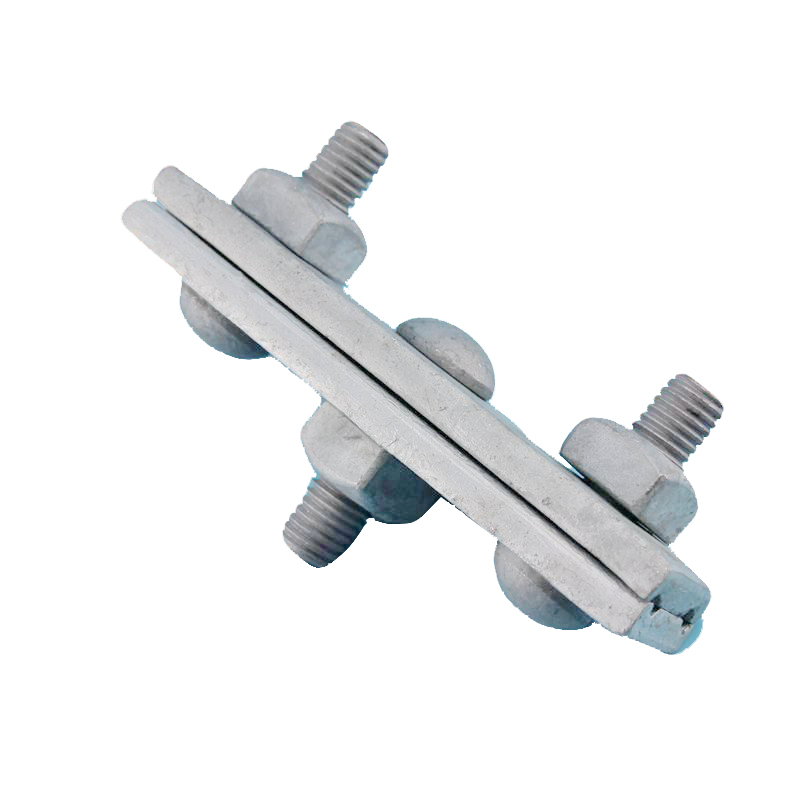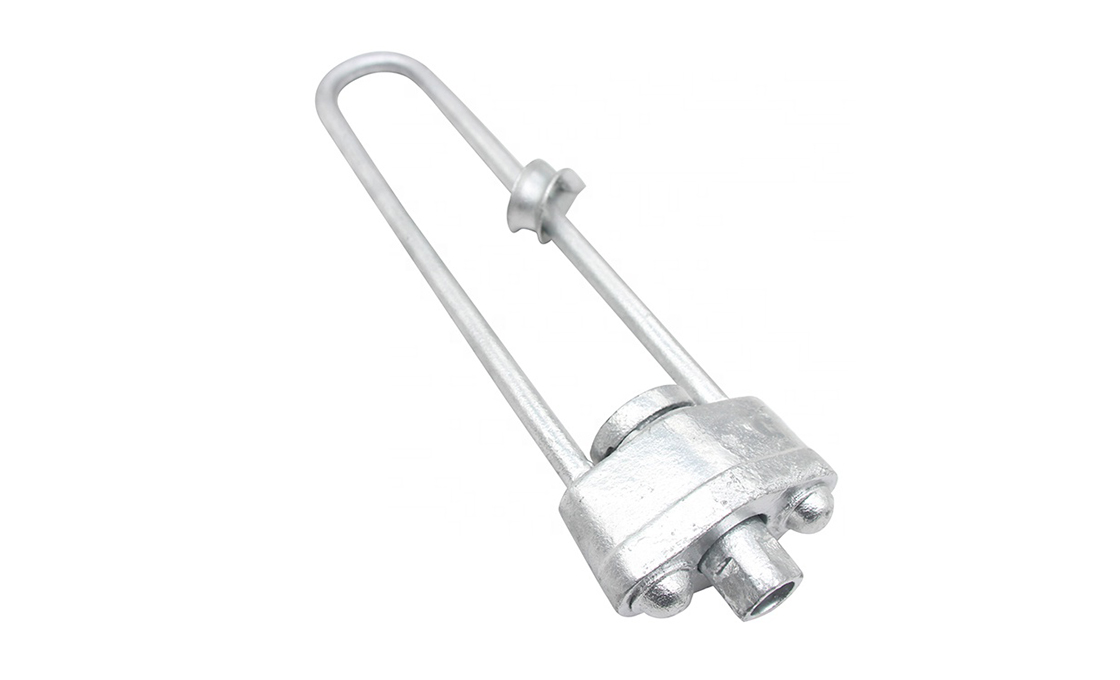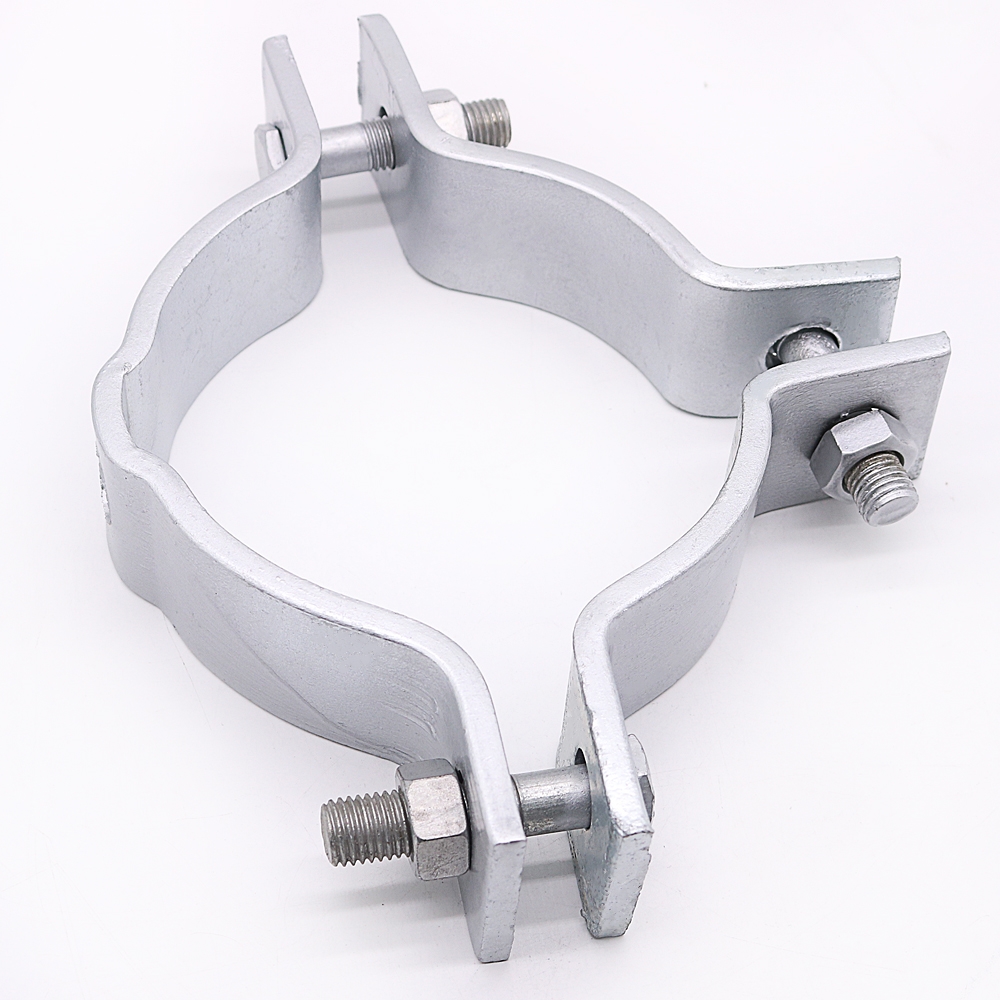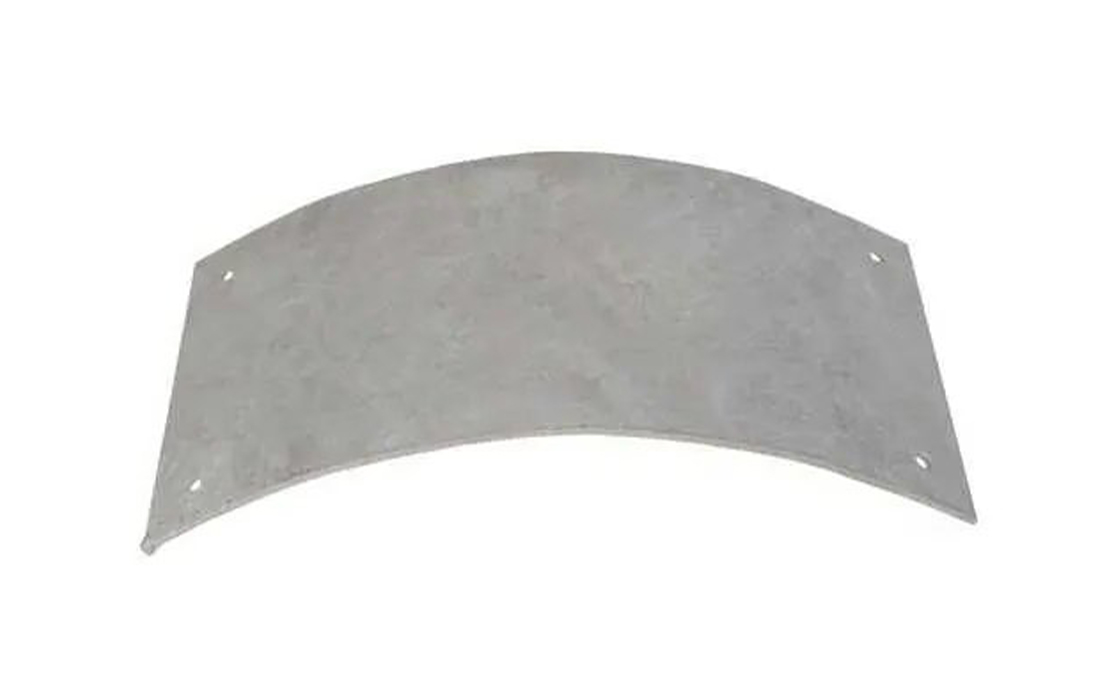
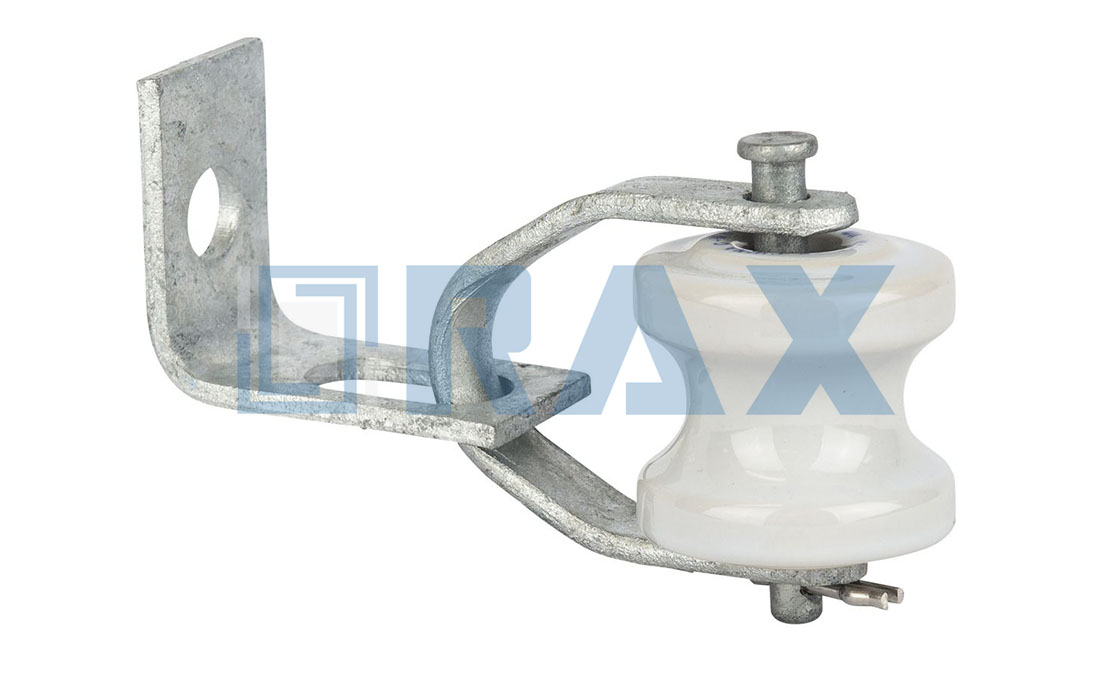
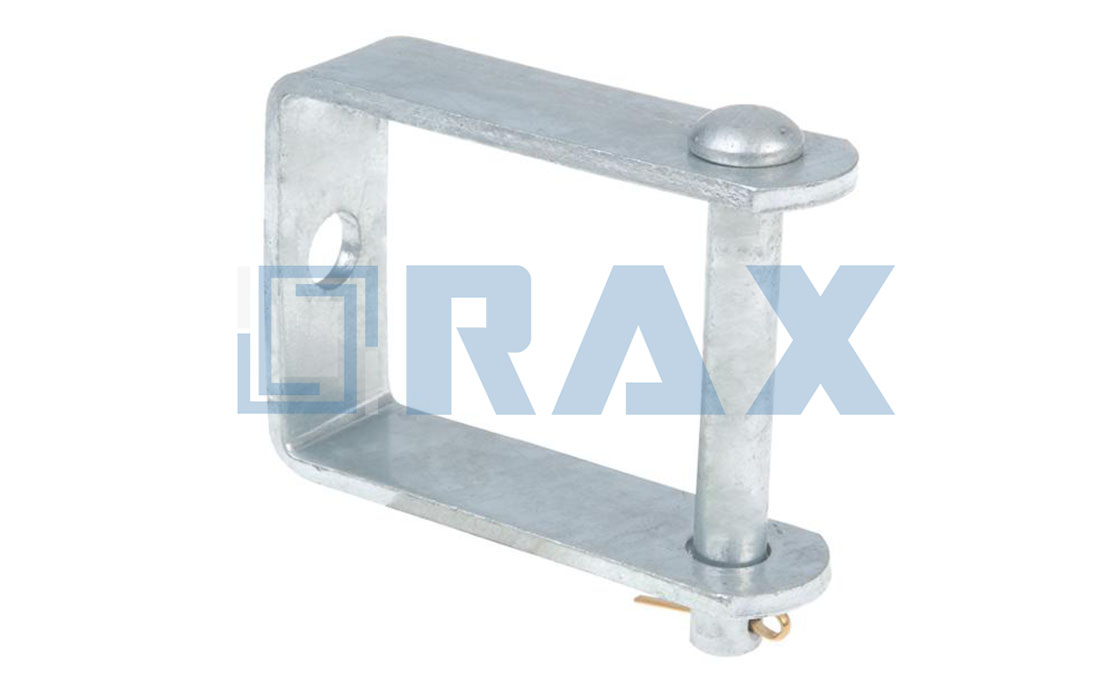
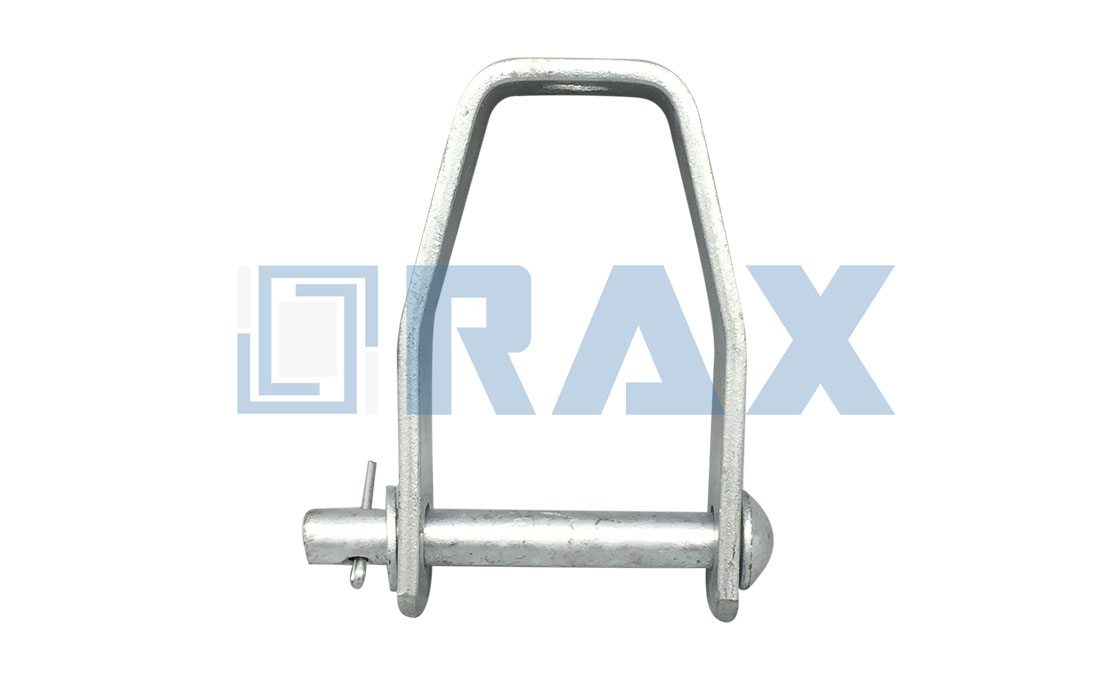
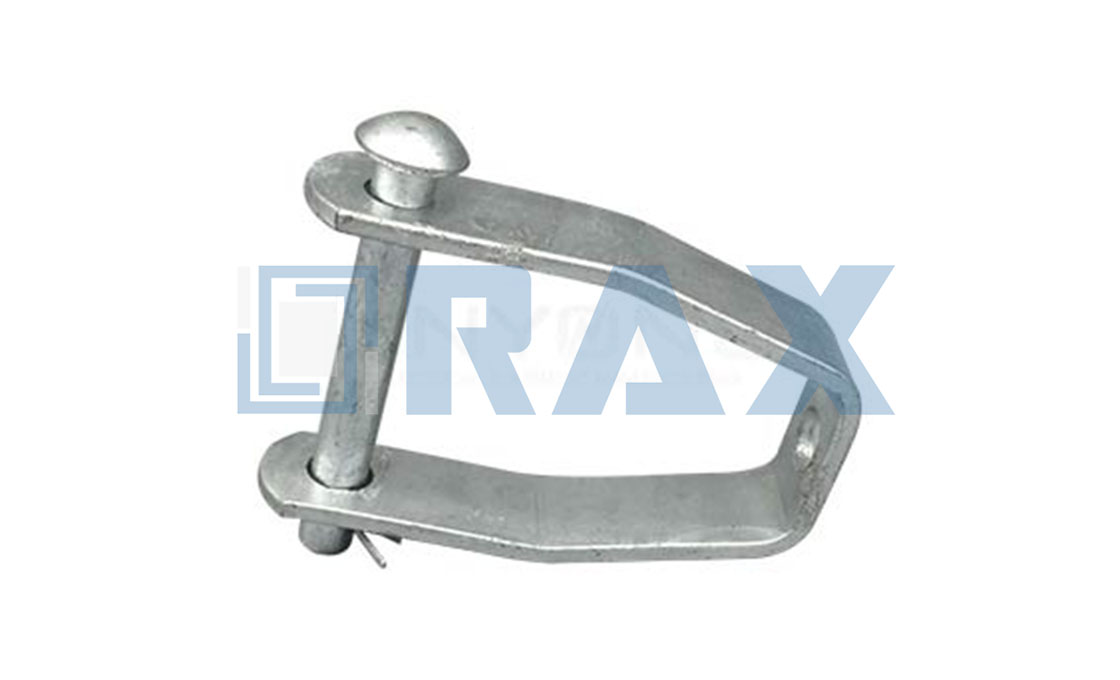
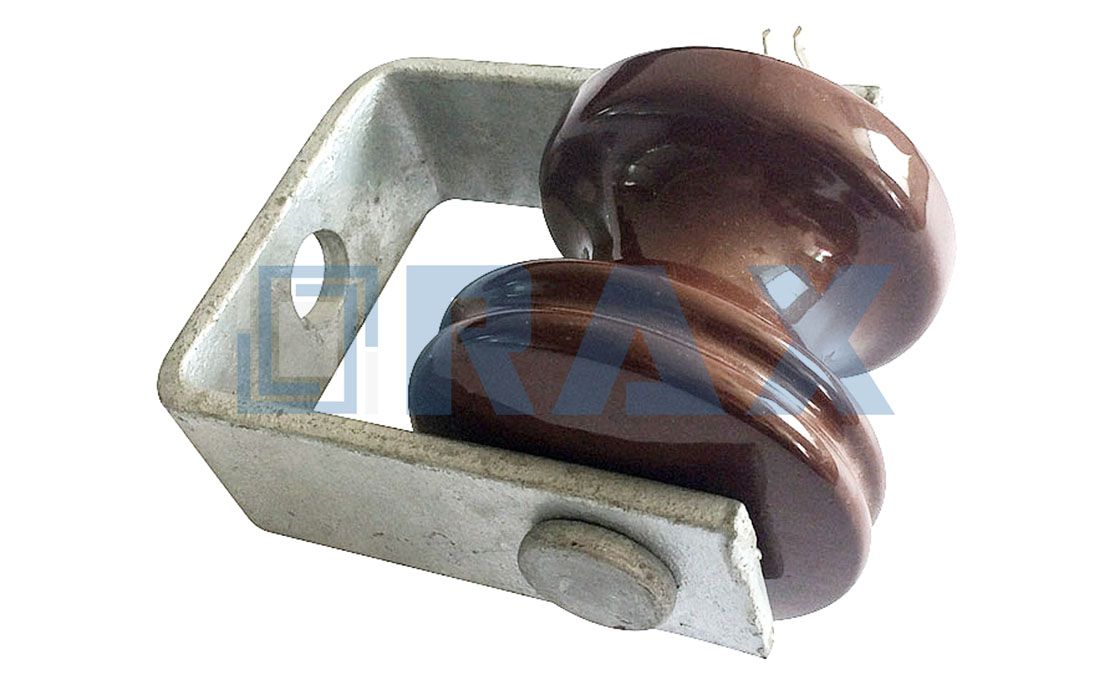
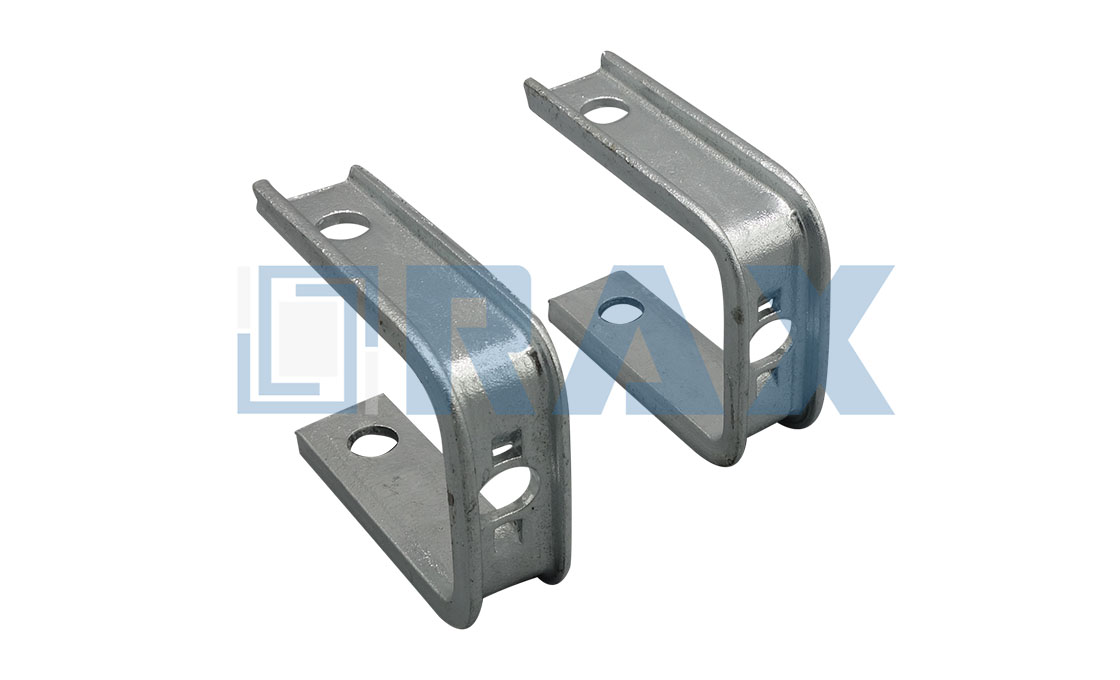
Deadend Clevis
- U-shape steel clevis that attaches a spool insulator and deadend conductor to the pole
- 4 ultimate-strength classes: 2,000 / 4,000 / 6,000 / 9,000 lb
- ANSI 53-1 / 53-2 / 53-3 spool insulator compatible
- Hot-dip galvanized to ASTM A-153 (body Class B, fasteners Class 3)
Technical Specifications
| Catalog | Ultimate (lb) | Rated (kN) | Insulator Class | Use Case | Bolt | Weight (kg) | Surface |
|---|---|---|---|---|---|---|---|
| RAX-DC-5 | 2,000 | 5 kN | ANSI 53-1 (1.75 in OD) | Service drops, light secondary | M12 | 0.4 | HDG |
| RAX-DC-8 | 4,000 | 8 kN | ANSI 53-2 (2.5 in OD) | Heavy secondary, light primary | M16 | 0.7 | HDG |
| RAX-DC-12 | 6,000 | 12 kN | ANSI 53-3 (3 in OD) | Standard primary distribution | M16 | 1.0 | HDG |
| RAX-DC-18 | 9,000 | 18 kN | Custom | Transmission grade, large pull | M20 | 1.6 | HDG |
Application & Installation
Where it is used
- Service drop dead-end terminations on customer-pole assemblies
- Secondary conductor dead-ends at branch tap-off poles
- Primary distribution dead-ends with spool or pin insulator
- Guy attachment with extension link (RAX-DC-12 and above)
- Substation egress conductor terminations
Installation sequence
- Mount the spool insulator inside the clevis U using the pivot pin.
- Pass the conductor’s deadend grip eye over the insulator’s groove.
- Insert the self-locking cotter pin through the pivot pin’s hole.
- Attach the clevis to the pole’s mounting bracket via the 5/8 in through-bolt.
- Torque the through-bolt to 80–100 ft-lb and verify the cotter pin is fully engaged.
- Tension the conductor and verify the insulator sits square in the clevis gap.
Buyer’s Guide: Deadend Clevis
1. What’s Included in a Complete Deadend Clevis Assembly
A complete deadend clevis ships as a four-piece kit: the U-shaped clevis body, the clevis pin (typ. 5/8 in diameter), a self-locking cotter pin (3/16 in standard), and the tang or attachment plate. All four interface at fixed pivot points; ordering the wrong combination is a common procurement error because some catalog pages list only the body. Verify at order that the kit is complete — if “clevis only” is specified on the PO, plan to source the matching pin set separately to the same ANSI dimensions. Raxsteel ships all four pieces as a complete kit by default unless you specify “body only” at order.
2. Forged vs Stamped Steel — Construction Method Matters
The clevis body is made by one of three methods: hot forging (highest strength, ~25–40% more expensive), cold stamping from flat plate (most common at lower load classes), or hot-rolled channel steel bent into U shape (mid-grade economy choice). Forged is the industry standard for primary distribution (>600 V) and any application requiring 5,000 lb+ ultimate. Stamped is suitable for secondary (≤600 V) and most service-drop dead-ends below 3,000 lb load. The third option — bent channel steel — gives 70–80% of forged strength at 60–70% of forged cost; common in mid-tier secondary applications. Specify construction method at order if your project drawing requires a specific type.
3. Sizing by Ultimate Strength & Insulator Class
Match the clevis ultimate strength to the conductor tension class with a 4:1 safety factor:
- 2,000 lb ultimate (RAX-DC-5, 5 kN) — service drops, light secondary up to 500 lb conductor tension
- 4,000 lb ultimate (RAX-DC-8, 8 kN) — heavy secondary, light primary, up to 1,000 lb tension
- 6,000 lb ultimate (RAX-DC-12, 12 kN) — standard primary distribution, up to 1,500 lb tension
- 9,000 lb ultimate (RAX-DC-18, 18 kN) — transmission and heavy distribution, up to 2,250 lb tension
Always verify against your project’s conductor sag-tension chart, not just nominal conductor size. A 4/0 ACSR at 200 ft span in heavy-ice loading can briefly exceed 3,000 lb — size for the maximum, not the average.
4. Spool Insulator Compatibility: ANSI 53-1 / 53-2 / 53-3
Three ANSI insulator classes dominate North American distribution, and the clevis interface (gap width, pin diameter, attachment slot) must match the insulator class:
- 53-1 — 2,000 lb ultimate, small porcelain 1.75 in OD; pairs with RAX-DC-5 for service drops
- 53-2 — 4,000 lb ultimate, mid porcelain 2.5 in OD; pairs with RAX-DC-8 for distribution secondary
- 53-3 — 6,000 lb ultimate, large porcelain 3 in OD; pairs with RAX-DC-12 for primary distribution
Mixing classes is an installation error that causes premature porcelain damage — a 53-2 insulator in a 53-1 clevis sits loose and rattles in wind. The cross-reference is encoded in our type: RAX-DC-{N} matches ANSI 53-{N−3} except for the 5-kN entry which is sized for 53-1.
5. Swinging vs Fixed Style — Field Adjustment Tradeoffs
A fixed (rigid) clevis bolts to the pole or crossarm at a fixed angle — simpler, cheaper, used where the conductor approach angle is known and stable. A swinging clevis includes a pivot at the pole-side attachment, allowing the clevis to rotate within a ±15° range. The swinging style adapts to slight crossarm misalignment, conductor sag changes over seasons, and temperature-induced expansion. Specify swinging at corners, branch tap-offs, and any installation where the conductor approach angle may change over time. The cost premium for swinging vs fixed is ~30%; the field-adjustment benefit usually outweighs it on any installation more complex than a simple residential service drop.
6. Galvanizing: ASTM A-153 Class B vs Class 3
Hot-dip galvanizing on deadend clevises follows two ASTM A-153 sub-classes: Class B on the body (minimum 86 μm coating thickness, suitable for C3 industrial atmosphere per ISO 9223) and Class 3 on the small parts — pivot pin, cotter pin, and washers (minimum 38 μm coating). For coastal or chemical-exposure environments (C4–C5 corrosivity), specify duplex coating (HDG + polyester powder paint) at order — service life jumps from ~25 years to 50+. Stainless steel construction is available for the most aggressive environments (offshore, chemical plant, oil refinery) with 10–14 day tooling lead time.