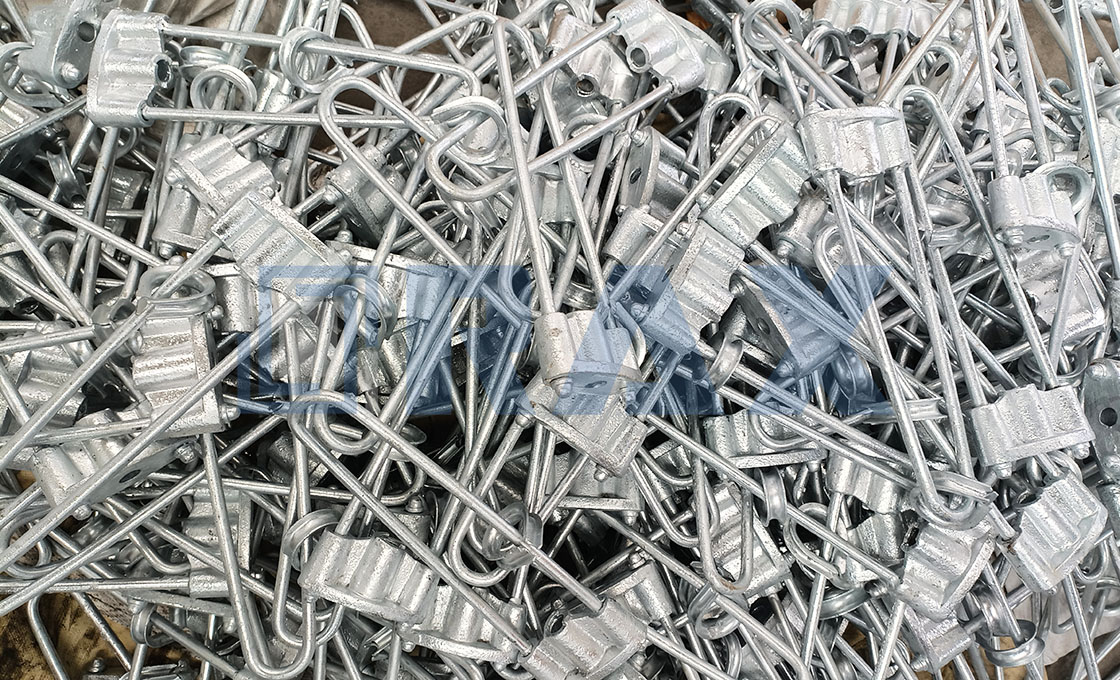
Stay Bow
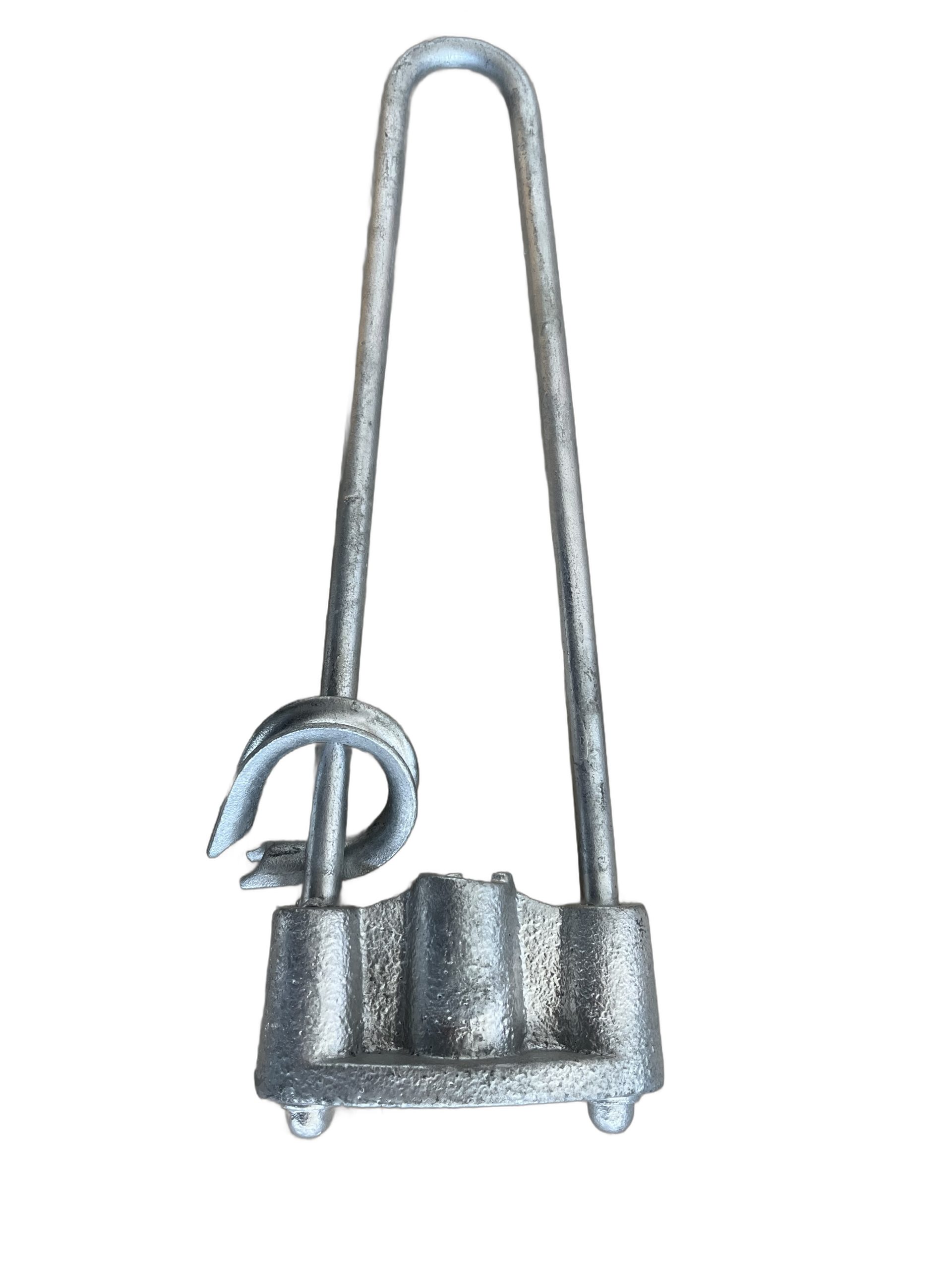
- Pole-side stay-wire anchorage assembly: U-bow + cast base + integrated thimble
- 4 types spanning 22–89 kN minimum breaking load, matching common Hubbell 6960–6963 stay-bow series
- Drop-forged steel bow + cast steel base, hot-dip galvanized per ASTM A153 / ISO 1461
- Mates with stay rod (RAX-SR-B / -SR-T series) via M16 / M20 / M22 threaded coupling
Technical Specifications
| Catalog | Bow Stock | Stay Wire Compat | Min Breaking Load | Coupling Thread | Hubbell Eq. | Weight (kg) |
|---|---|---|---|---|---|---|
| RAX-SB-A | 8 mm round | up to 7/32″ (5.5 mm) | 22 kN (5,000 lb) | M16 LH/RH | 6960 | 0.65 |
| RAX-SB-B | 10 mm round | 1/4″–5/16″ (6–8 mm) | 35 kN (8,000 lb) | M16 LH/RH | 6961 | 0.95 |
| RAX-SB-C | 13 mm round | 3/8″–7/16″ (10–11 mm) | 62 kN (14,000 lb) | M20 LH/RH | 6962 | 1.55 |
| RAX-SB-D | 16 mm round | 1/2″–5/8″ (13–16 mm) | 89 kN (20,000 lb) | M22 LH/RH | 6963 | 2.40 |
Application & Installation

Where it is used
- Service-drop dead-end termination at the customer-side pole top (light bow, RAX-SB-A/B)
- Distribution-class guy wire anchorage at corner / dead-end poles (RAX-SB-B/C)
- Sub-transmission guy stays where wind load + ice load drives 50+ kN MBL requirements (RAX-SB-C/D)
- Marine and coastal substation yards where bow-style cast base resists creep better than thin-plate alternatives
- Retrofit replacement of failed cast-iron-only stay bracket assemblies during line refurbishment
Installation sequence (bow + rod assembly)
- Confirm stay wire gauge against bow throat width (see type table) — using an undersized bow causes stay wire fretting at the throat radius.
- Thread the stay wire through the bow opening, then over the integral thimble — the thimble's curved channel must seat fully against the wire.
- Form the stay wire dead-end below the thimble using a preformed dead-end grip (NOT clips or bulldogs).
- Couple the bow base's LH-thread terminal to the matching RH-thread end of the stay rod via the supplied turnbuckle / ratchet nut.
- Tension to the design load (typically 25–40% of MBL) using a calibrated tensioner; verify with a dynamometer for sub-transmission stays.
- Apply zinc-rich cold-galvanizing paint to any tool-marked or scratched zones on the bow throat or coupling thread before energizing.
Buyer’s Guide: Stay Bow
1. What the Stay Bow Actually Is — Three Components Pre-Assembled
A Stay Bow is not one part but a three-component cluster shipped as a single type: the U-shaped drop-forged steel bow (the loop your stay wire passes through), the cast steel base (the heavy block that anchors the bow and houses the threaded coupling), and the integral thimble (the curved channel that protects the stay wire from fretting at the bow contact). The full force path runs: stay wire → thimble channel → bow throat → bow legs → cast base → coupling thread → stay rod → buried plate. The stay bow occupies the pole-top side of the assembly; the stay rod (see RAX-SR-B / -SR-T) is the buried-side counterpart. Together they form a complete stay set, but the bow itself is a discrete spare-parts line: utilities order bows separately when refurbishing aged stays without disturbing the underground anchor.
2. Bow Throat Width & Stay Wire Gauge Compatibility
The single most-critical sizing decision is matching the bow throat width (the inside dimension of the U-loop) to the stay wire diameter. Too narrow and the wire binds at the radius, concentrating stress and accelerating fatigue; too wide and the wire shifts under load, abrading both the bow and the thimble. The Raxsteel type table maps directly to common 3/8″ 7-strand, 5/16″ 7-strand, and 1/4″ 7-strand stay wire gauges per ASTM A475 Class A — if your utility uses metric 8 mm or 10 mm stay wire (IEC 50183), RAX-SB-B and -C respectively are the matched sizes. Never use a stay bow one size larger than the stay wire on the assumption that a bigger bow is "safer": the wire will rest at the bottom of the throat, off-center from the thimble channel, and fail at the bow / thimble interface within 5 years.
3. Forged Bow vs Cast-Only Construction — Why Drop-Forged Matters
Cheap stay bows are cast iron throughout (bow legs and base poured as one piece in a sand mold). They're ~30% cheaper but have two failure modes utility specs flag: brittle fracture at the bow / base junction under cyclic wind load, and hidden casting porosity that degrades MBL by 15–25% from the rated value. Raxsteel stay bows use drop-forged steel bows (BS EN 10025-2 S275JR, hot-die forged at 1100°C then normalized) mated to cast steel bases (NOT cast iron) via a shrink-fit + welded interface. The bow itself is ductile under impact, the base is dense and grain-aligned, and the MBL ratings on the type table are guaranteed minimums after destructive testing on 1 of every 50 production units — not nominal averages. The cost premium over cast-only is ~$1.50 / unit, recovered within the first year of service life difference.
4. The Thimble — Why It's Not Optional
Some low-cost stay assemblies skip the integral thimble, relying on the bow's inside radius to support the stay wire directly. This is acceptable for static, low-load applications (light service drops) but fails fast in any guy wire role. The thimble does three jobs the bow cannot: it provides a continuous smooth curve matching the wire's natural bend radius (the bow has corners at the leg-to-throat junction); it distributes contact pressure across 180° of the wire's circumference (the bow contacts only the wire's outer surface); and it "wears out" first as a sacrificial element, which is far cheaper to replace than the entire bow assembly. All Raxsteel types ship with the thimble integrally cast / welded into the base — no field installation, no missing parts on receipt. For C4-C5 corrosion environments, specify the 316L stainless thimble upgrade (option code -SS) at order; the bow stays drop-forged carbon steel with HDG.
5. Coupling Thread to the Stay Rod — M16 / M20 / M22 LH+RH
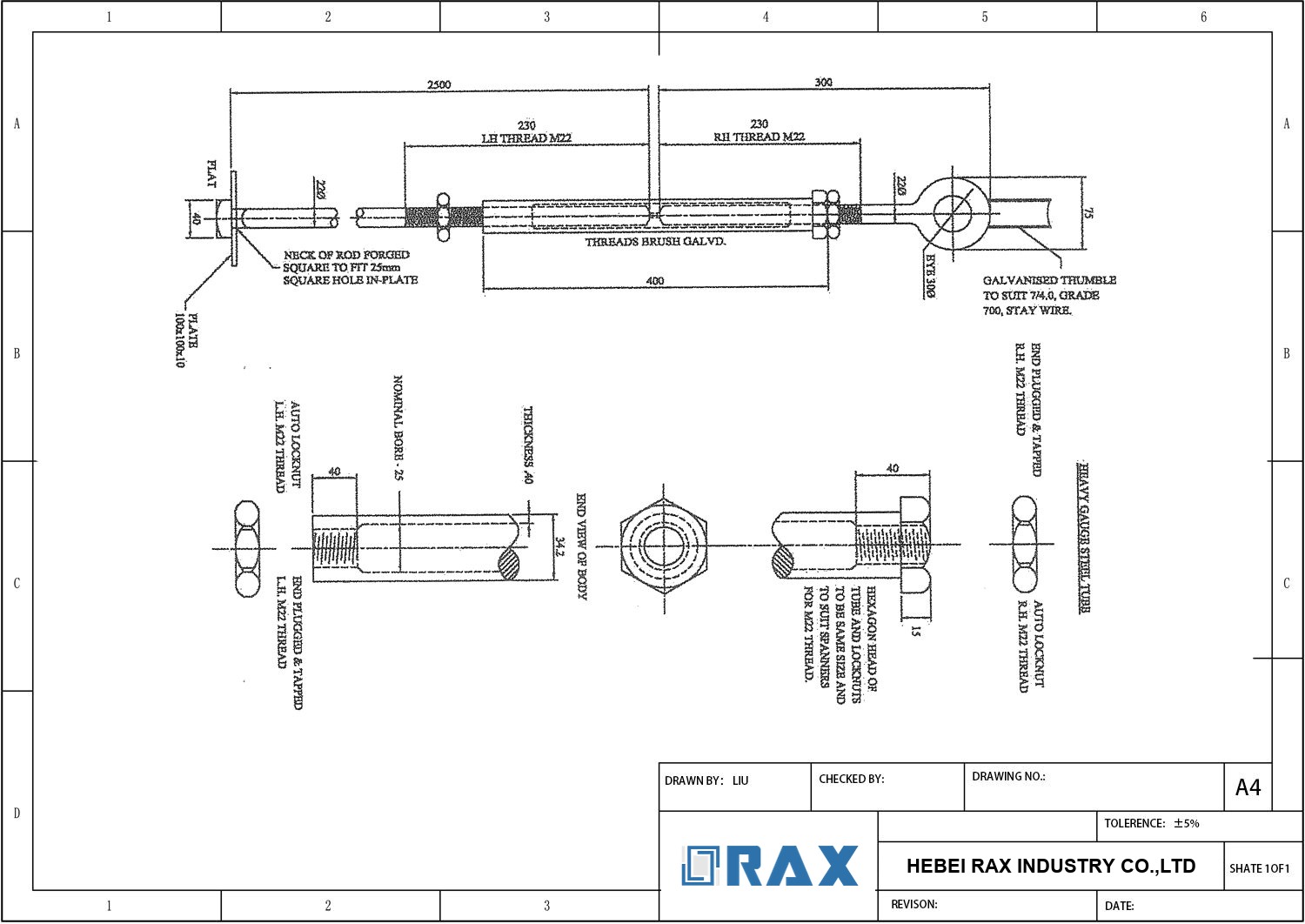
The stay bow does not exist as an end product — it must couple to a stay rod that runs from pole-base level down to the buried anchor. The coupling is a left-hand-thread + right-hand-thread turnbuckle arrangement: one end of the stay bow base has a LH thread, the matching end of the stay rod has a RH thread, and rotating the connecting ratchet nut tensions or de-tensions the whole assembly without rotating the bow or rod themselves. Coupling thread sizes match the RAX stay rod series: M16 for RAX-SB-A and -B (paired with RAX-SR-B-58 or -T-58), M20 for RAX-SB-C (paired with RAX-SR-B-34), and M22 for RAX-SB-D (paired with RAX-SR-B-1 or -T-1). If you're replacing only the bow on an existing stay, measure the existing rod thread and specify the size in your order — we'll match.
6. Galvanizing for Strand-Contact Hardware (Why 110 μm, Not 86 μm)
ASTM A153 Class B sets the floor at 86 μm zinc coating for hot-dip galvanized fittings. Raxsteel stay bows are specified to 110 μm typical — about 28% above floor — for one specific reason: the stay wire moves under thermal expansion, wind buffeting, and seismic events, and this micro-movement abrades the zinc at the throat contact point at ~5–8 μm per year in C3 atmospheric environments (rural / suburban). At 86 μm the bow throat starts showing red rust within 12–15 years; at 110 μm it lasts 20+. For C4 (urban industrial / coastal) and C5 (marine / heavy chemical) sites, specify duplex coating (HDG + epoxy paint on the bow throat zone) at order; this extends service life to 40+ years. Stainless 316L bow construction is also available for sites where any rust is unacceptable, at ~4× the carbon-steel price.