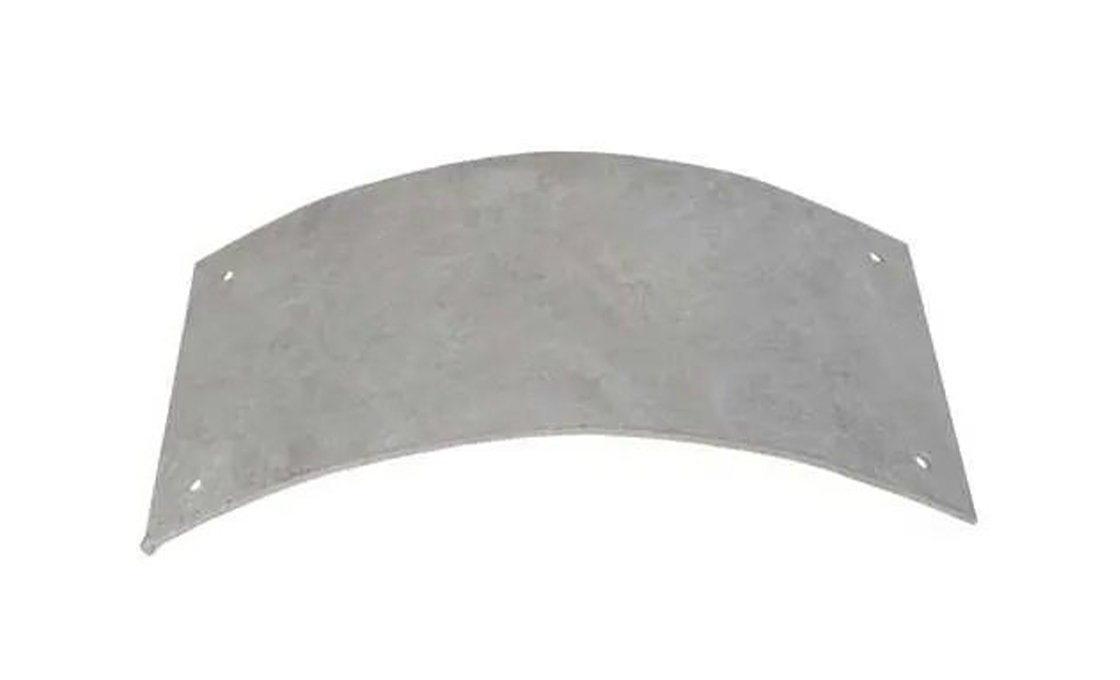
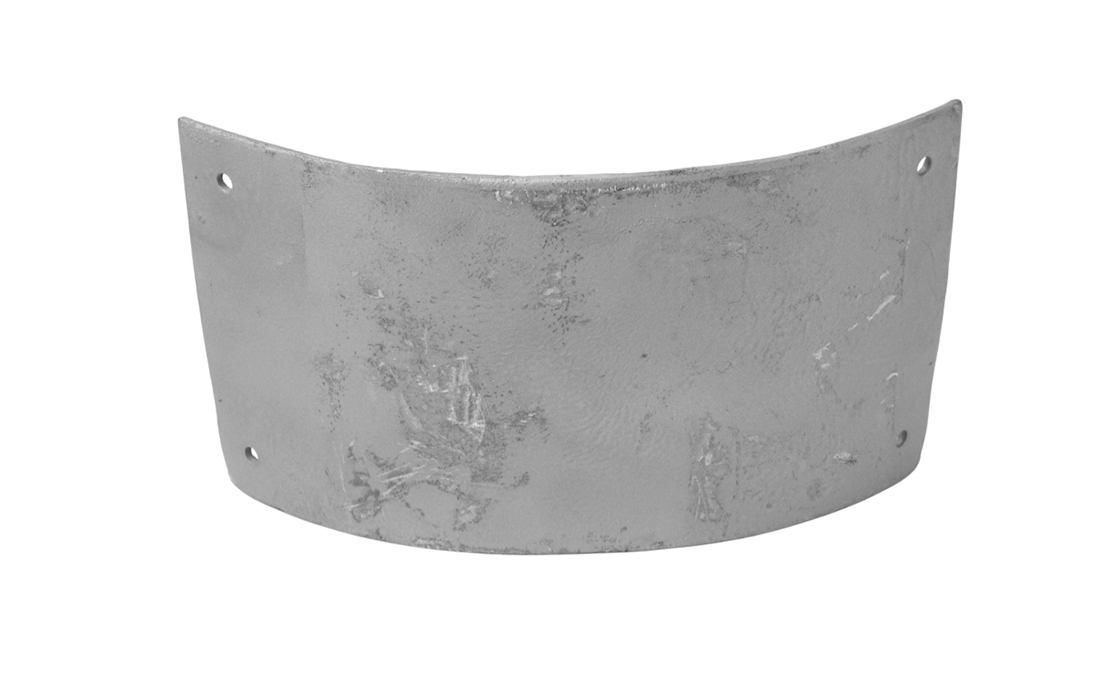
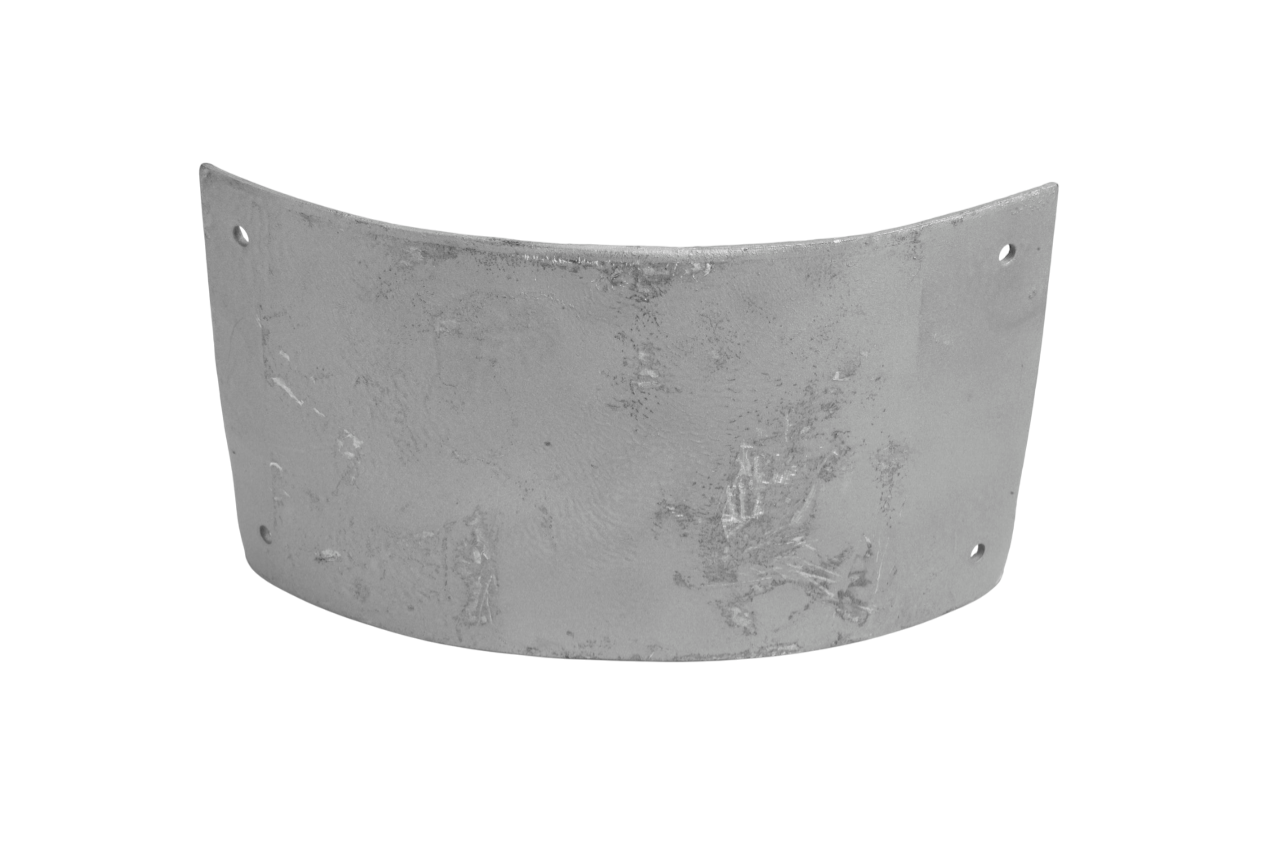
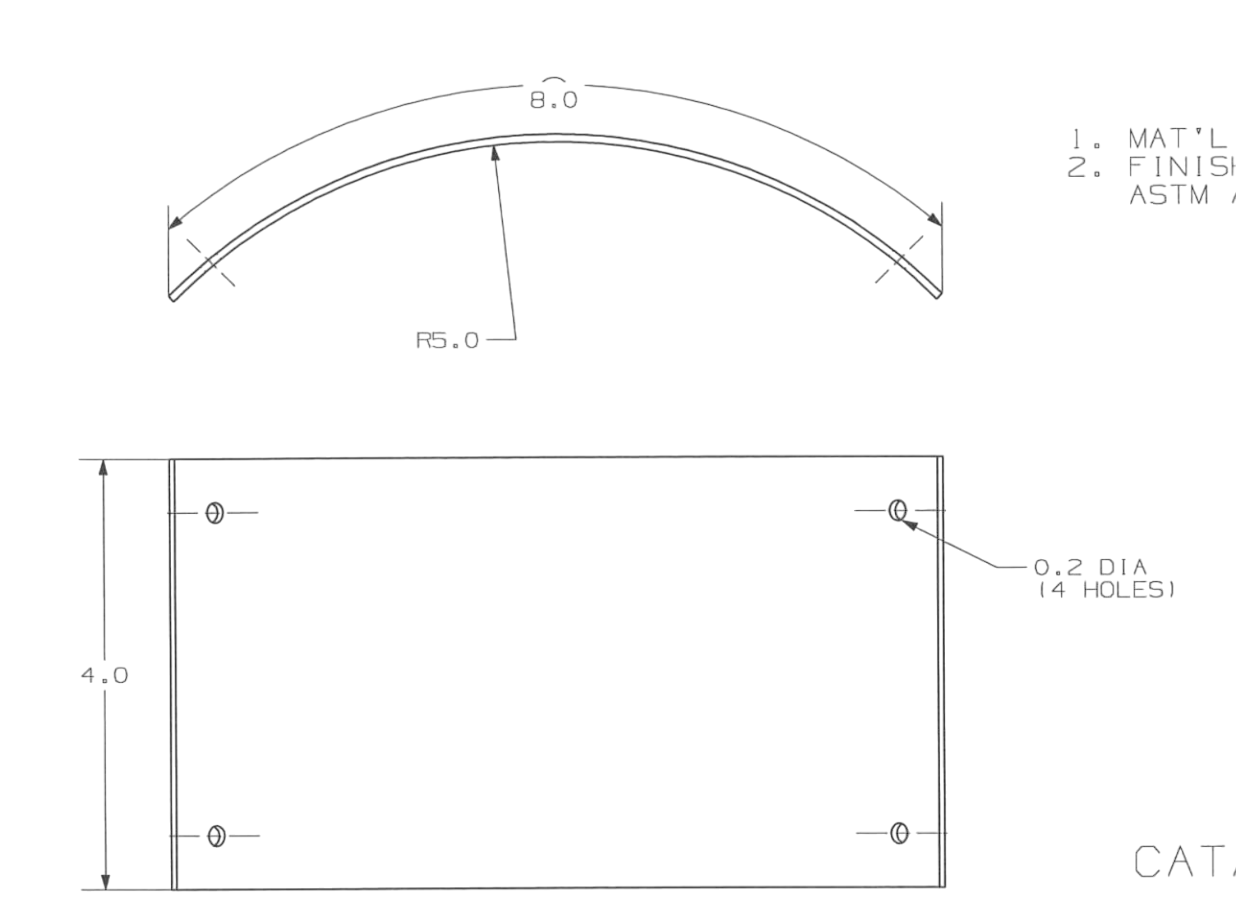
Strain Plate
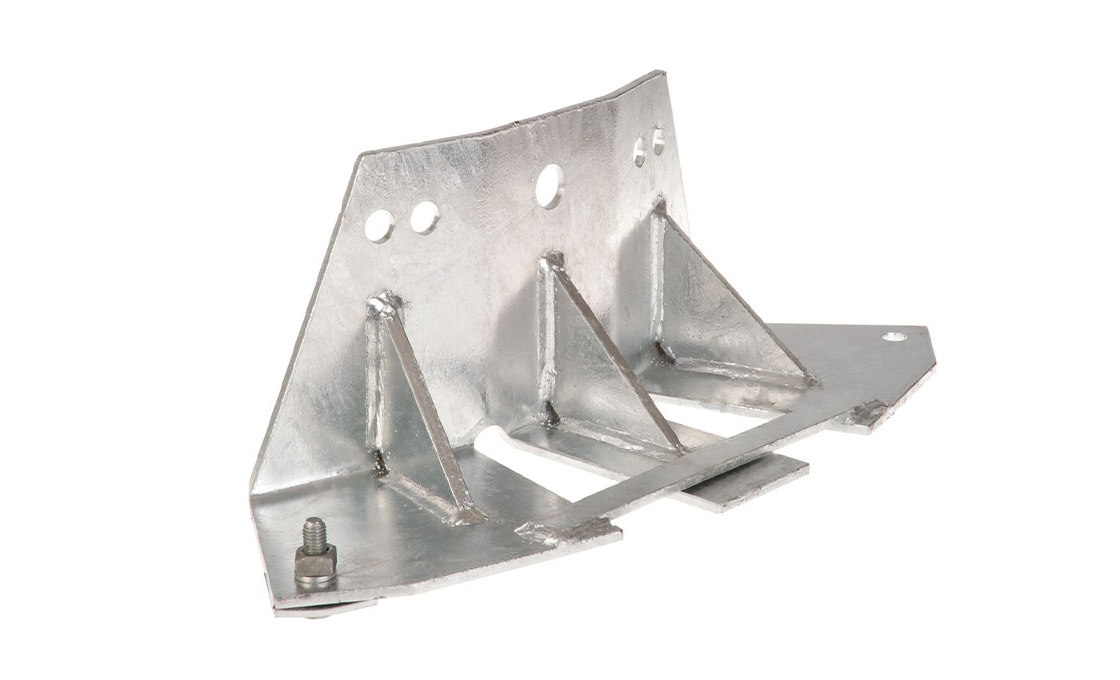
- Curved steel plate that protects a wood pole from guy-wire cut-in under wrapped guy installations
- 4 types: 4×6 / 4×8 / 5×10 / 6×12 inch (matches Hubbell 6575 + larger sizes)
- 3/16 in nail holes — preserves pole structural integrity vs through-bolt mounting
- Hot-dip galvanized to ASTM A153 Class B
Technical Specifications
| Catalog | Dimensions | Radius | Nail Hole | Holes | Sheet Thickness | Weight (kg) | Use Case |
|---|---|---|---|---|---|---|---|
| RAX-SP-4×6 | 4 in × 6 in | R4 in | 3/16 in | 4 | 12 gauge (2.7 mm) | 0.30 | Light secondary, telecom |
| RAX-SP-4×8 | 4 in × 8 in | R5 in | 3/16 in | 4 | 12 gauge (2.7 mm) | 0.45 | Standard distribution (Hubbell 6575 eq.) |
| RAX-SP-5×10 | 5 in × 10 in | R6 in | 1/4 in | 4 | 10 gauge (3.4 mm) | 0.85 | Heavy distribution |
| RAX-SP-6×12 | 6 in × 12 in | R7 in | 1/4 in | 6 | 10 gauge (3.4 mm) | 1.40 | Transmission, large-diameter poles |
Application & Installation
Where it is used
- Wrapped-guy distribution pole installations (the most common use case)
- Telecom messenger-strand wrap protection on shared-use poles
- Service-drop strand wrap-mount at residential customer poles
- Light transmission pole guy wraps (smaller plates) where anchor-guy isn’t feasible
- Reinforcement plate under any hardware that sees concentrated lateral load on pole face
Installation sequence (wrapped guy with strain plate)
- Position 2 plates on the pole face where the guy wrap will pass: top of wrap area and bottom of wrap area, typically 8–12 in apart vertically.
- Pre-drill 1/8 in pilot holes at the plate’s 4 corner positions (wet softwood only; hardwood needs no pilot).
- Drive 8d common nails (or 3/16 in roofing nails) through each corner, flush to the plate surface.
- Begin the guy wrap above the upper plate and complete it below the lower plate so the wire bears across both plates.
- Tension the guy wire to the design load; the wrap pressure now holds the plates in place permanently.
- Verify each nail is flush; protruding nails will catch on the guy wire and fray the strand over time.
Buyer’s Guide: Strain Plate
1. What’s a Strain Plate (and Why Is It Called "Strain"?)
The name is misleading and is a frequent source of procurement confusion. A strain plate does NOT carry deadend conductor strain — it has nothing to do with the conductor side of a pole assembly. Instead, it’s a curved steel bearing plate that mounts on a wood pole’s face under a wrapped guy wire, protecting the wood from the guy strand cutting into the fibers under tension. The name comes from the early 20th century when telecom and electric utilities used "guy strain" to refer to any taut wire on a pole — in modern usage this would more accurately be called a "guy wrap bearing plate" or "wood pole guard plate." If your procurement system or warehouse uses a different name, treat "Hubbell 6575" or "curved strain plate" as the universally-understood catalog reference and confirm dimensions at order.
2. Wrapped Guy vs Anchor Guy: When You Need a Strain Plate
Two methods exist for terminating a guy wire on a utility pole. Anchor guy runs the strand from the pole head down to a ground anchor and uses a deadend clevis + guy clamps + stay rod assembly — the guy is mechanically held by hardware at both ends. Wrapped guy (also called Hawaiian guy or pole-to-pole guy) wraps the strand around the pole and back on itself, using the friction of the wrap plus the strand’s own tension to hold itself in place — no hardware termination at the pole side. Wrapped guy is the older method, still common in rural distribution and some telecom installations. Strain plate is ONLY needed for wrapped guy — anchor guy doesn’t touch the pole’s wood surface, so no protection plate is required. If your project uses anchor guys exclusively, you don’t need strain plates.
3. Sizing: Plate Dimensions & How Many Per Pole
Plate dimensions are selected by pole diameter and guy strand size. 4 in × 6 in (RAX-SP-4×6) — light secondary on poles up to 7 in diameter, 1/4 in guy strand. 4 in × 8 in (RAX-SP-4×8, Hubbell 6575 eq.) — standard distribution on 7–10 in poles, 5/16 in or 3/8 in strand. 5 in × 10 in (RAX-SP-5×10) — heavy distribution on 10–14 in poles, 3/8 in or 1/2 in strand. 6 in × 12 in (RAX-SP-6×12) — transmission on 12–20 in poles, 1/2 in or 5/8 in strand. Quantity per pole: 2 plates minimum placed at the top and bottom of the wrap area, 4 plates recommended for transmission-class guys (top + upper-middle + lower-middle + bottom of wrap). The plate’s curvature radius is matched to typical pole radius at the installation diameter — ordering the wrong curvature is the most common installation error.
4. Hubbell 6575 vs MacLean vs Generic: Catalog Equivalency Map
The North American utility hardware market converges on the 4 in × 8 in size as the de-facto industry standard for distribution. Hubbell 6575 (originally Chance Hubbell, now Hubbell Power Systems) and MacLean Power Systems‘s strain plate listed under their "Plates" product line are dimensionally interchangeable — 8 in × 4 in body, R5 in curvature, four 3/16 in nail holes at corners, hot-dip galvanized to ASTM A153. RAX-SP-4×8 is built to identical specifications and substitutes 1:1 into any Hubbell-spec or MacLean-spec project drawing. The other 3 sizes (4×6, 5×10, 6×12) extend the range above and below the standard for lighter and heavier applications respectively; these aren’t all available in the Hubbell catalog but follow the same curvature-matched geometry.
5. Why Nails Instead of Bolts? The Wood-Pole Engineering Reason
Strain plates are nailed, not bolted, and this is deliberate engineering. Bolts require a clearance hole (typically 11/16 in for a 5/8 in bolt), which cuts through the load-bearing wood fibers and creates a moisture-ingress channel that accelerates rot at the bolt’s depth. Nails (3/16 in dia) compress wood fibers radially without severing them — the pole’s cross-sectional strength is essentially unaffected. The strain plate carries only compressive load (the wrapped guy presses it against the pole), not tensile pull, so a structural fastener isn’t needed; the wrap’s friction holds the plate in place once the guy is tensioned. Pre-drill 1/8 in pilot holes in wet softwoods (Cedar, Pine) to prevent splitting at the plate corners; hardwood (Locust, Oak) typically needs no pilot. Don’t substitute self-tapping screws or lag bolts — they accelerate wood degradation and don’t add holding power vs nails for this application.
6. Galvanizing for Wood-Pole Embedded Hardware: ASTM A153 Class B
Strain plates sit between a wet wood pole face (which holds moisture seasonally) and a galvanized steel guy strand — a galvanic-couple risk if the plate’s coating is too thin. ASTM A153 Class B requires minimum 86 μm zinc coating; we ship at 100 μm typical on strain plates specifically to extend service life in this damp interface. The plate’s expected service life in C3 atmospheric corrosivity is 30+ years; in C4 coastal or industrial conditions, 20–25 years — specify duplex coating (HDG + epoxy paint, 5–7 day tooling) for 50+ years in C4. Stainless 316L construction is available for the most aggressive environments (offshore wind, oilfield, chemical plant), at 3× cost with 10–14 day tooling lead time.