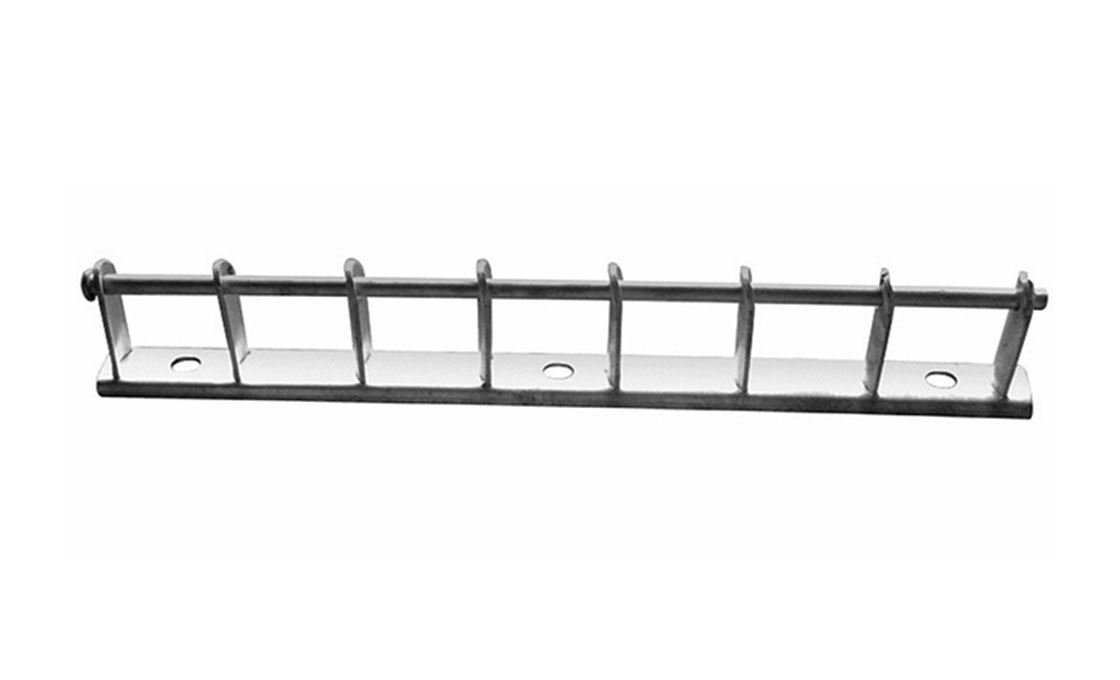
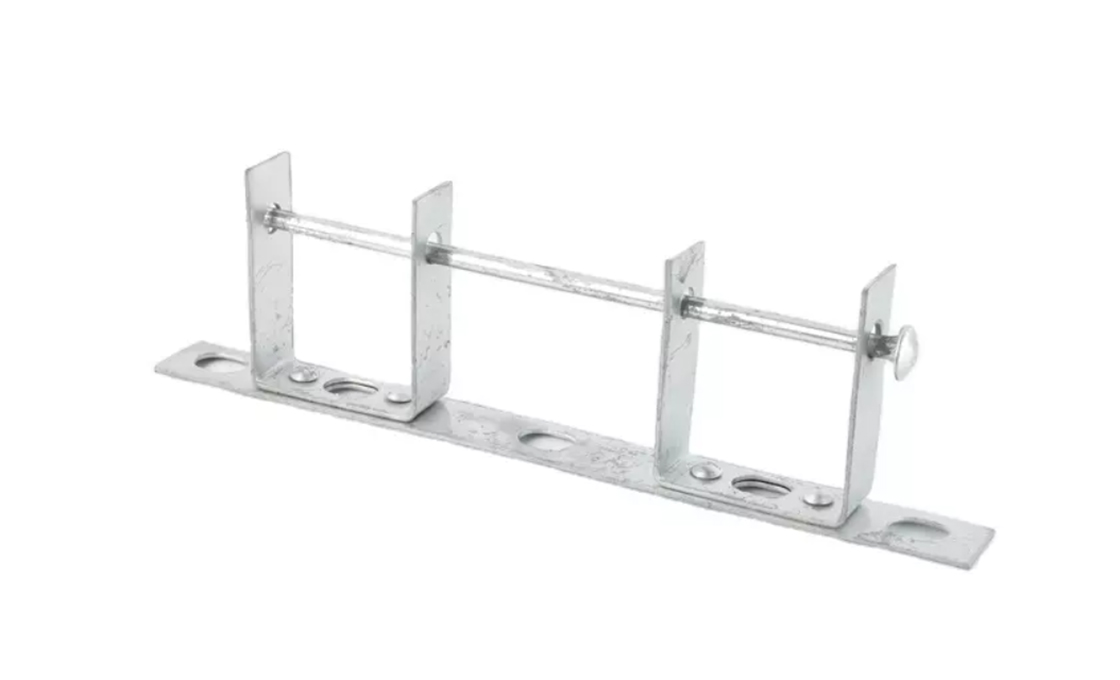
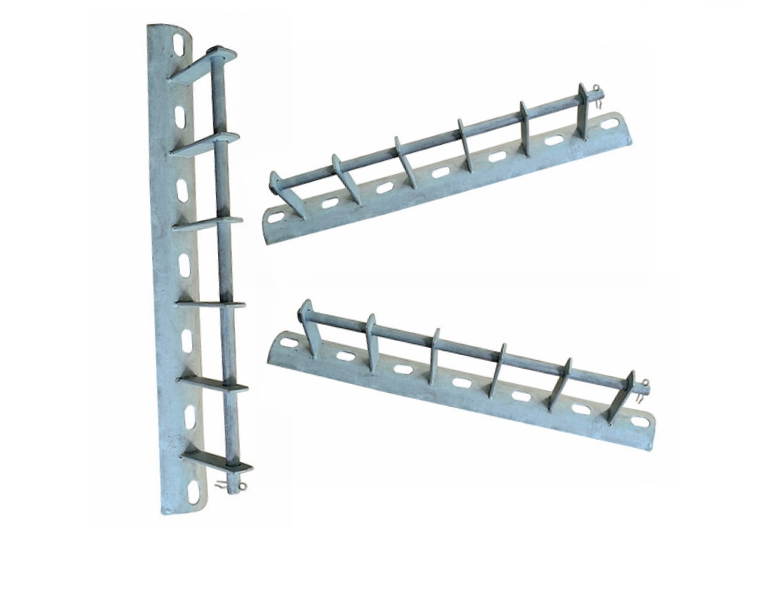
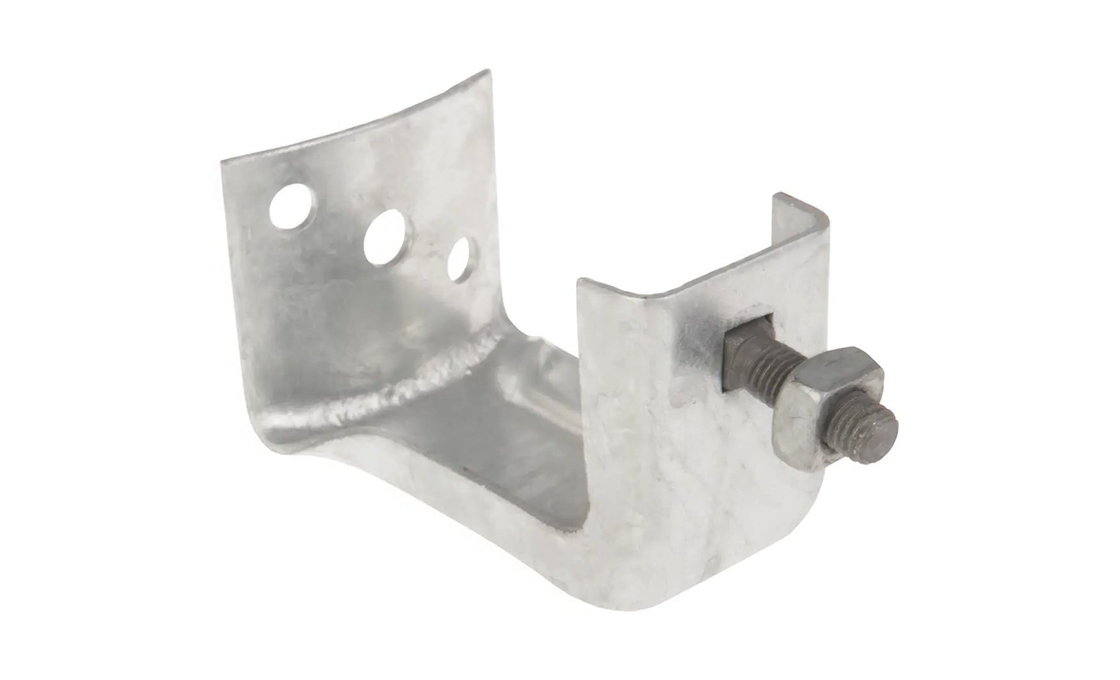
Secondary Rack
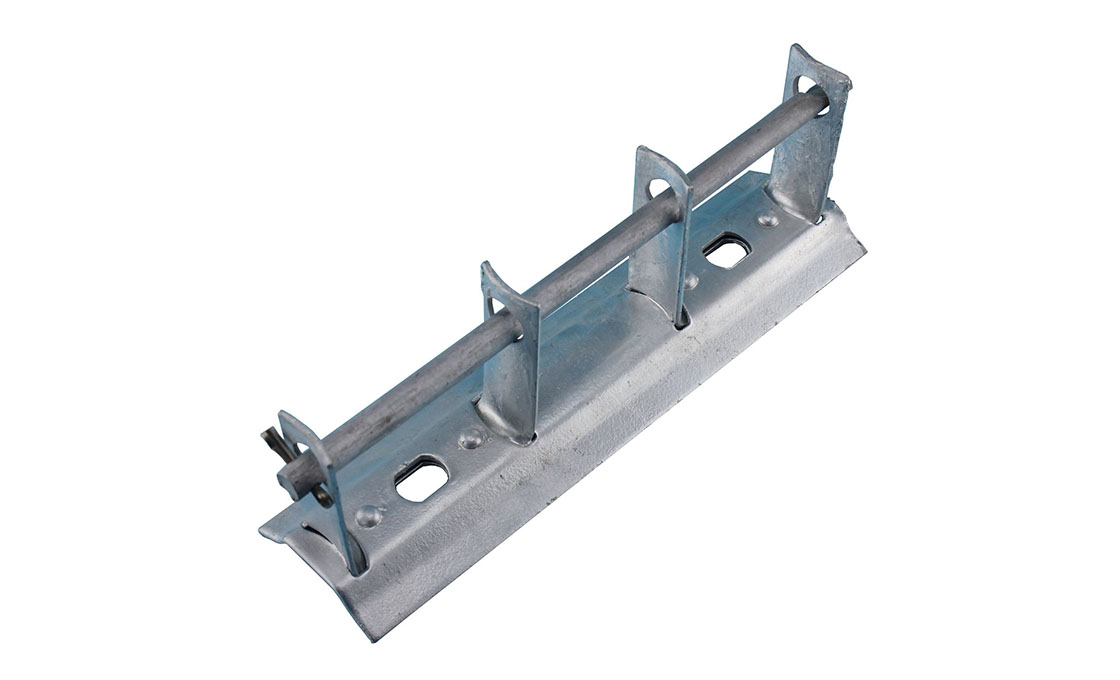
- Pole-mounted bracket carrying 2–4 spool insulators for secondary & neutral service drop conductors
- 6 types spanning 2/3/4-wire counts × medium / heavy duty × extended / non-extended back
- Ships pre-assembled with ANSI 53-2 spool insulators (porcelain gray standard, polymer optional)
- Hot-dip galvanized steel body per ASTM A153 / ISO 1461 (86–110 μm)
Technical Specifications
| Catalog | Wire Count | Steel Gauge | Duty Class | Back Type | Insulator Class | Hubbell Eq. | Weight (kg) |
|---|---|---|---|---|---|---|---|
| RAX-SCR-2W-MD | 2-wire | 12 ga (.109″ / 2.77 mm) | Medium | Non-extended | ANSI 53-2 porcelain | Light service drop | 1.8 |
| RAX-SCR-3W-MD | 3-wire | 12 ga (.109″ / 2.77 mm) | Medium | Non-extended | ANSI 53-2 porcelain | T2070110 eq. | 2.5 |
| RAX-SCR-3W-HD | 3-wire | 9 ga (.148″ / 3.76 mm) | Heavy | Non-extended | ANSI 53-2 porcelain | T2070109 eq. | 3.4 |
| RAX-SCR-3W-EX | 3-wire | 12 ga (.109″ / 2.77 mm) | Medium | Extended back | ANSI 53-2 porcelain | PSC2070175 eq. | 2.8 |
| RAX-SCR-4W-MD | 4-wire | 12 ga (.109″ / 2.77 mm) | Medium | Non-extended | ANSI 53-2 porcelain | T2070114 eq. | 3.2 |
| RAX-SCR-EXT | Extension bracket | 10 ga (.135″ / 3.42 mm) | — | — | — | Mates with any SCR rack | 0.55 |
Application & Installation
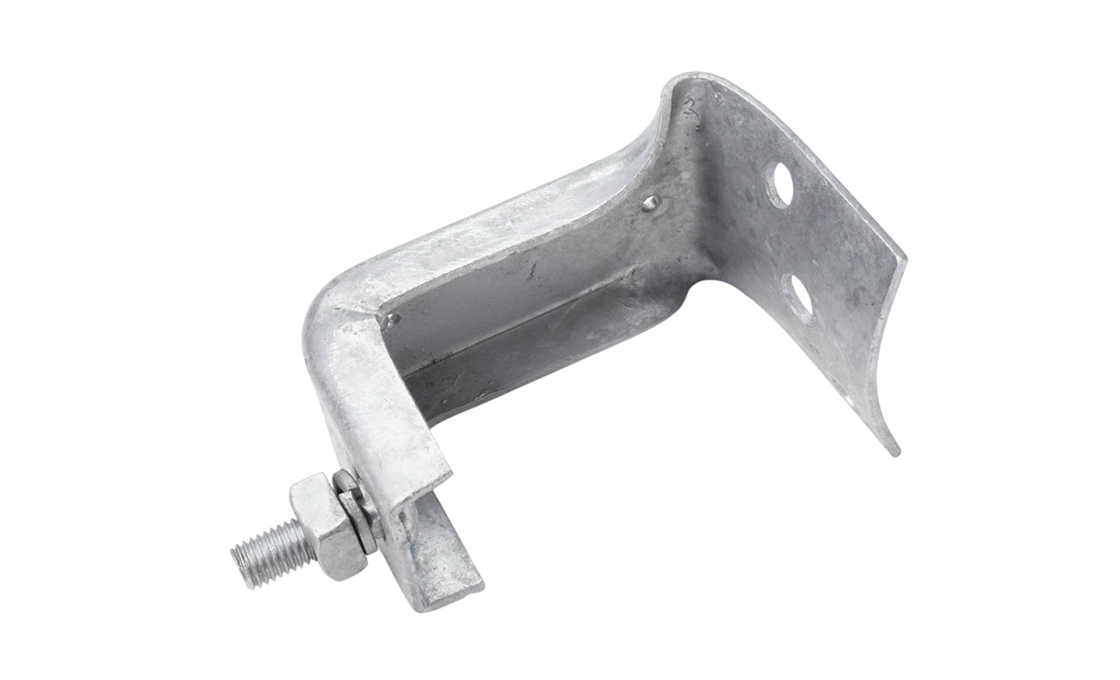

Where it is used
- Service drop dead-end at residential and small-commercial customer poles (2-wire, 3-wire RAX-SCR-2W/-3W-MD)
- Urban distribution neutral run on the lowest crossarm position (4-wire RAX-SCR-4W-MD)
- Heavy-load applications with messenger-supported secondary or triplex/quadruplex bundled conductor (RAX-SCR-3W-HD)
- Thick wood poles or fiberglass composite poles where the extended-back variant provides necessary clearance (RAX-SCR-3W-EX)
- Retrofit upgrades on aged porcelain spool racks where the spools are intact but the steel body has rusted through
Installation sequence (3-wire medium duty, wood pole)
- Mark mounting position on pole face at least 12 in below the lowest energized primary conductor per NESC Rule 235 vertical clearance.
- Drill two 11/16″ (17 mm) through-holes spaced per the rack's mounting hole pattern (typically 9 in for 3-wire, 12 in for 4-wire).
- Attach the rack to the pole using two 5/8″ × 12″ HDG machine bolts with curved washers on the back side — do not use lag bolts on a rack carrying live secondary.
- Verify the rack is plumb and the spool axes are horizontal; mis-aligned spools cause uneven conductor wear and shortened insulator life.
- Run conductor through each spool by removing the cotter pin, lifting the spool bolt, threading the conductor against the spool groove, and re-inserting the spool bolt + cotter pin.
- Dead-end the conductor at the far spool using a service wedge clamp or preformed dead-end grip; never rely on the spool friction alone to anchor a service drop.
Buyer’s Guide: Secondary Rack
1. What the Secondary Rack Actually Does in a Service Drop
A Secondary Rack is the multi-spool insulated bracket mounted on the customer-side pole face that terminates the secondary (240/120 V) and neutral conductors of a service drop run. It serves three functions simultaneously: mechanical anchorage (holds the conductor tension at the dead-end), electrical isolation (the porcelain or polymer spool insulators separate each conductor from the grounded steel body), and conductor separation (maintains the NESC-required 6–12 in spacing between energized service conductors and the neutral). The rack is the workhorse of low-voltage distribution: every overhead service to a single-family residence, small commercial building, or distribution pole-mounted transformer uses one. Hubbell's T2070-series is the de-facto North American spec; the Raxsteel SCR catalog matches it dimensionally and rates each type for direct utility cross-reference.
2. 2-Wire vs 3-Wire vs 4-Wire: Choosing Spool Count
The wire count matches your service drop configuration. 2-wire (RAX-SCR-2W-MD) is for old 120 V service drops (line + neutral) found on rural infrastructure dating to before 1965 — rarely specified for new construction but commonly stocked for repair. 3-wire (RAX-SCR-3W-MD) is the dominant type for residential 240/120 V split-phase service (two energized lines + neutral) — covers ~80% of single-family service drops in North America. 4-wire (RAX-SCR-4W-MD) is for 3-phase commercial drops (three energized lines + neutral) at small offices, restaurants, light industrial. If your spec calls for messenger-supported triplex or quadruplex bundled conductor, the messenger sits in the extra (top) spool position, so step up one wire count from the conductor count.
3. Medium Duty (12 ga) vs Heavy Duty (9 ga) Steel
The duty class is set by the steel sheet thickness of the rack body. Medium duty is 12 gauge (.109″ / 2.77 mm) — rated for ~1,800 lb working load per spool position, sufficient for residential service drops and standard secondary spans up to 100 ft. Heavy duty is 9 gauge (.148″ / 3.76 mm) — rated for ~3,500 lb per spool, used for messenger-supported runs, ice-load zones, and any application where the conductor sags carry significant horizontal pull. Hubbell's T2070109 is the canonical 9-gauge heavy-duty type; the Raxsteel equivalent is RAX-SCR-3W-HD. Don't over-spec — heavy duty costs ~40% more per rack and the extra steel is wasted weight on light service drops; conversely, don't under-spec in ice-storm zones (Northeast US, Eastern Canada, mountain West) where transient ice loads can triple the conductor weight.
4. Extended-Back vs Non-Extended: Pole Clearance Geometry
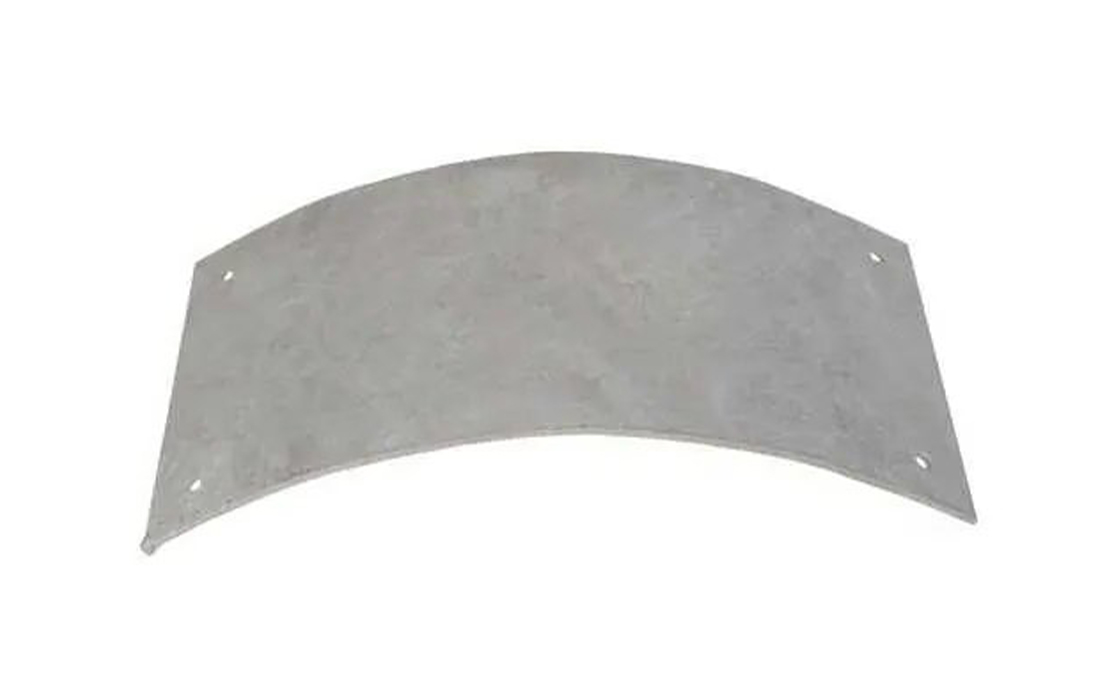
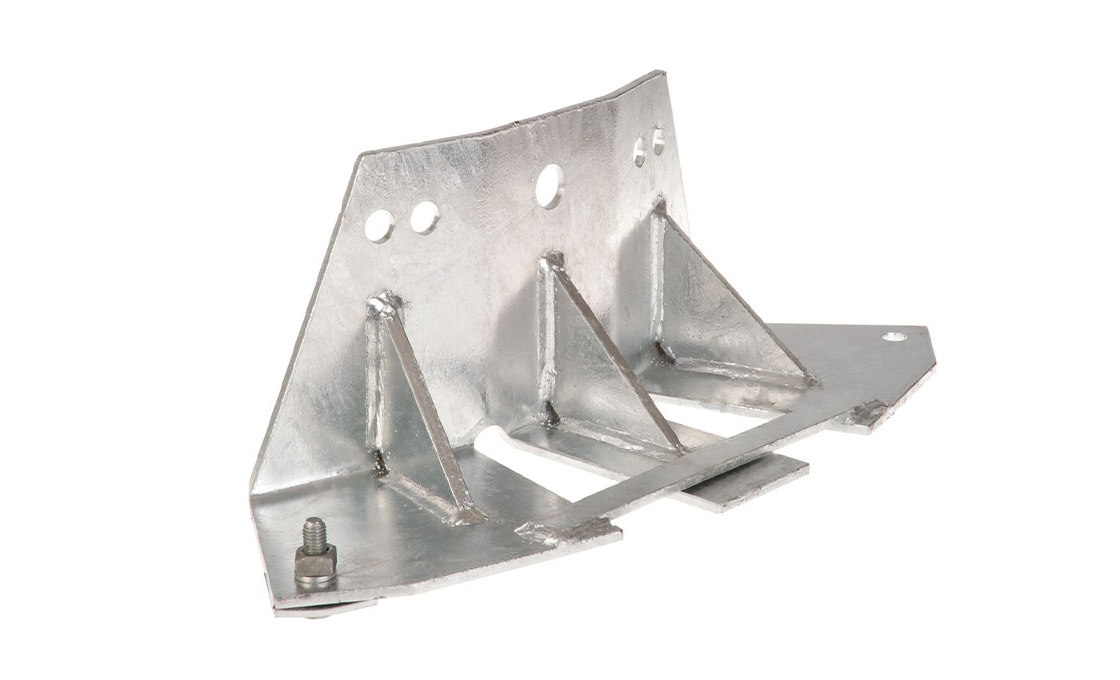
The back of the rack is the mounting flange that sits flush against the pole face. Non-extended back is the standard configuration: the flange is the same depth as the rack body, the spools sit 3–4 inches off the pole. Extended back (RAX-SCR-3W-EX, Hubbell PSC2070175 eq.) has a flange that extends 1–2 in beyond the rack body on each side, increasing the offset between the energized spools and the pole face. You need extended-back when the pole is oversized in diameter (Western Red Cedar > 12 in butt diameter, Class 1 or larger), when there are climbing irons or pole steps already mounted near the rack location, or when the local utility spec calls for > 6 in clearance from any energized service conductor to the pole face for arc-flash safety. Order extended-back if any of these apply.
5. Spool Insulator Selection: ANSI 53-2 Porcelain (Default) vs Polymer
The spool insulators that ship pre-assembled on every Raxsteel rack are ANSI 53-2 gray porcelain by default — the dominant spec across North American utilities, rated for 600 V (low-voltage service), with a smooth glazed surface that resists conductor cutting under cyclic load. Polymer (HDPE / polyethylene) spools are an equally-rated substitute: lighter (15% weight savings), unbreakable on drop (porcelain shatters), and available in 5 colors (gray / white / yellow / brown / black) for utility-coded identification of phase or function. Polymer is preferred for cold-climate utilities (porcelain micro-cracks at ≤ -40°C), for service trucks where drop damage is a concern, and for any utility that color-codes its secondary distribution. The cost premium is ~$0.30 per spool — trivial relative to total install cost.
6. Galvanizing & the Spool Bolt Corrosion Path
The Secondary Rack's hot-dip galvanizing matters in two specific places the standard spec doesn't emphasize: the spool bolt thread and the cotter pin hole. The bolt thread carries the spool insulator and is rotated during install (zinc abrasion); the cotter pin hole accumulates moisture (capillary action) and rusts from the inside out. Raxsteel specifies 110 μm HDG (Class B+) on the rack body AND the spool bolt, with the cotter pin holes centrifuged dry after galv bath to prevent zinc puddling that blocks the hole. For C4–C5 corrosion environments (coastal, salt-spray, industrial chemical), specify duplex coating (HDG + epoxy on the body) and stainless 316L spool bolts — this extends service life from ~25 years to 50+ in marine environments. The cost premium for full duplex + 316L bolts is ~$3.50 per rack.