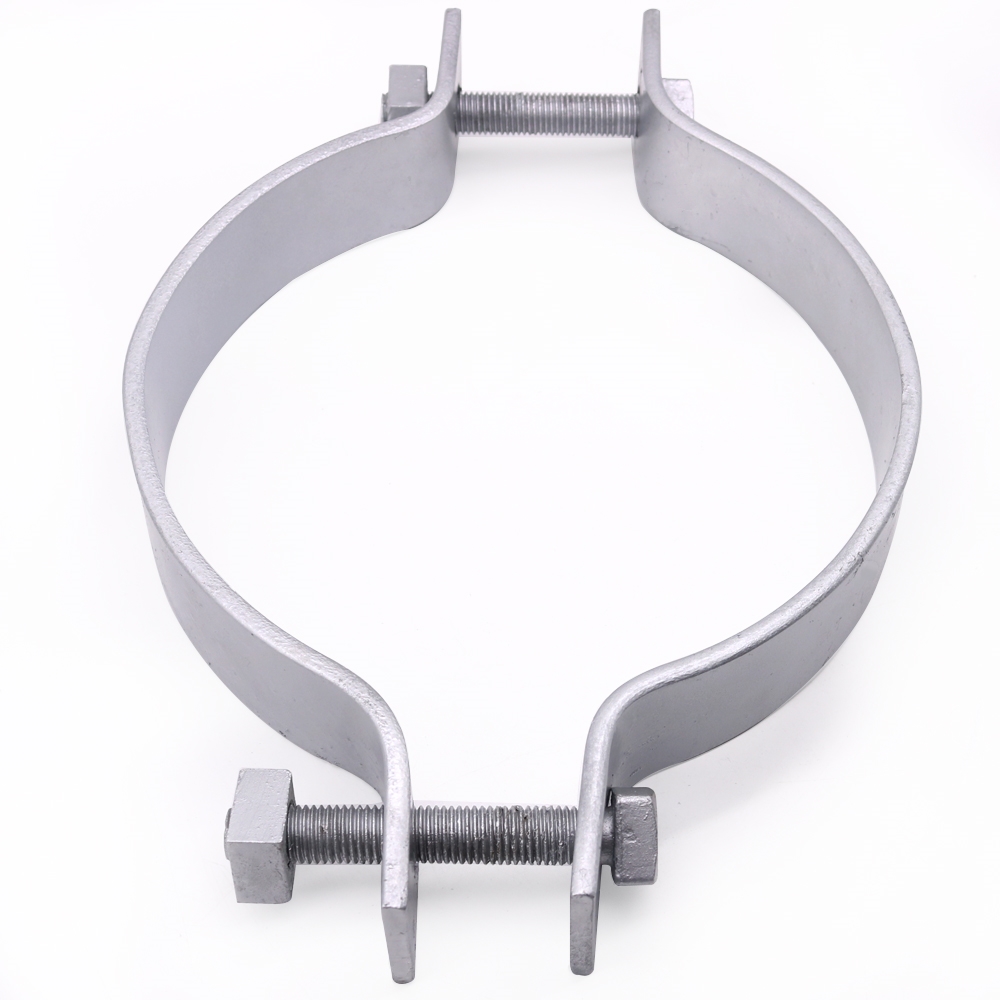
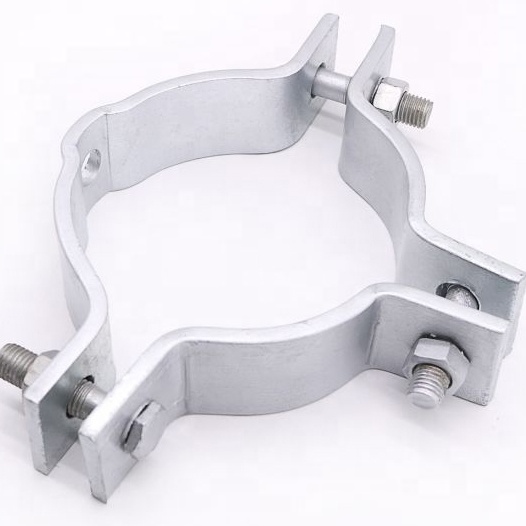
Pole Band
- Steel band that wraps around a utility pole to provide hardware attachment points
- 6 types: single offset, double offset V-saddle, 3-bolt closed, adjustable, link style
- 15,000 to 30,000 lb tensile rated for distribution and transmission
- Hot-rolled carbon steel, hot-dip galvanized to ASTM A153 (NOT cut sheet)
Technical Specifications
| Catalog | Type | Pole Diameter Range | Tensile | Hardware | Use Case | Weight (kg) |
|---|---|---|---|---|---|---|
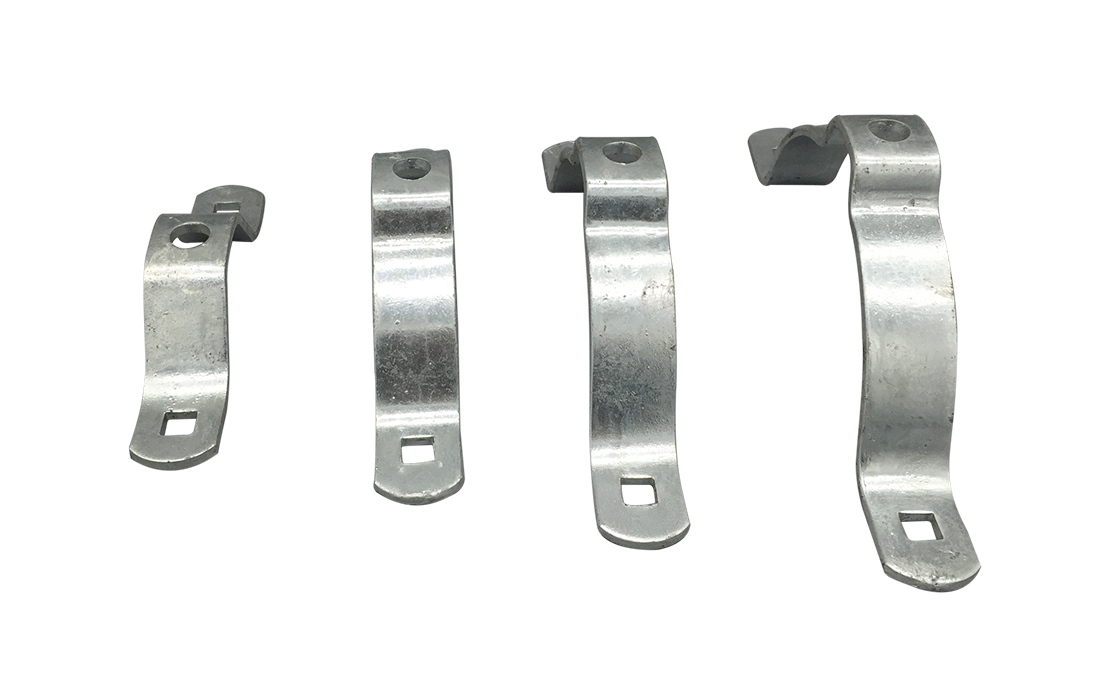
| RAX-PB-SO-180 | Single Offset | 6–7 in (152–178 mm) | 15,000 lb | 2 × M16 | Light distribution, single hardware mount | 0.60 |
| RAX-PB-SO-220 | Single Offset | 7–9 in (178–229 mm) | 15,000 lb | 2 × M16 | Standard distribution | 0.80 |
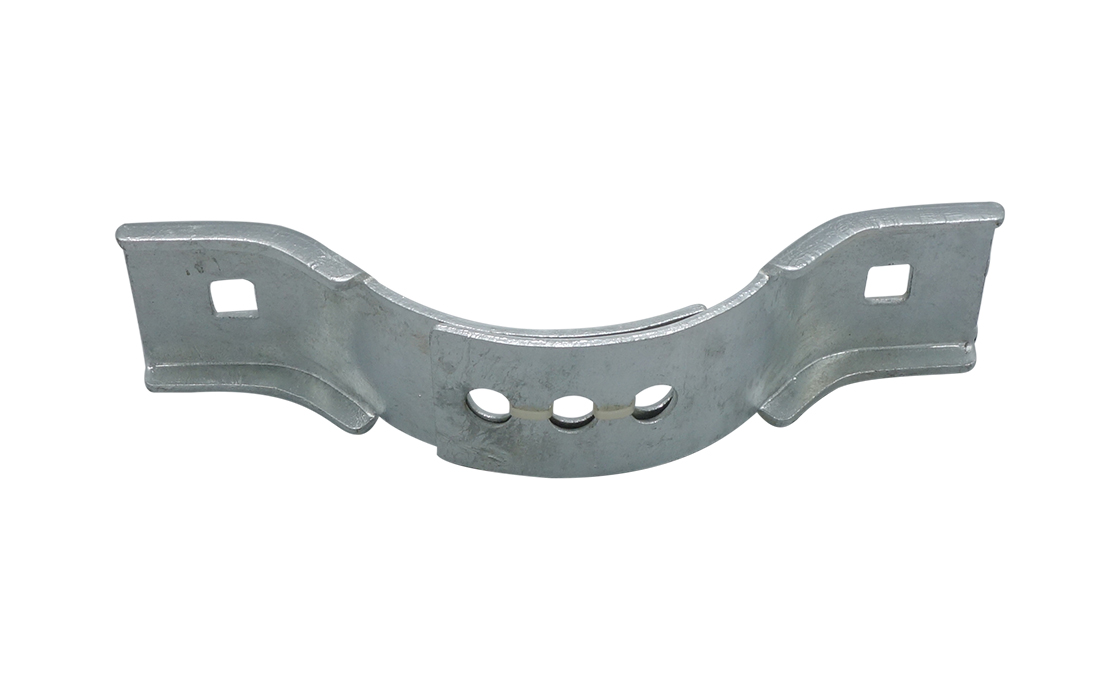
| RAX-PB-DO-V200 | Double Offset V-Saddle | 8–10 in (203–254 mm) | 15,000 lb | 2 × M16 | Crossarm / transformer mount, dual attachment slots | 1.10 |
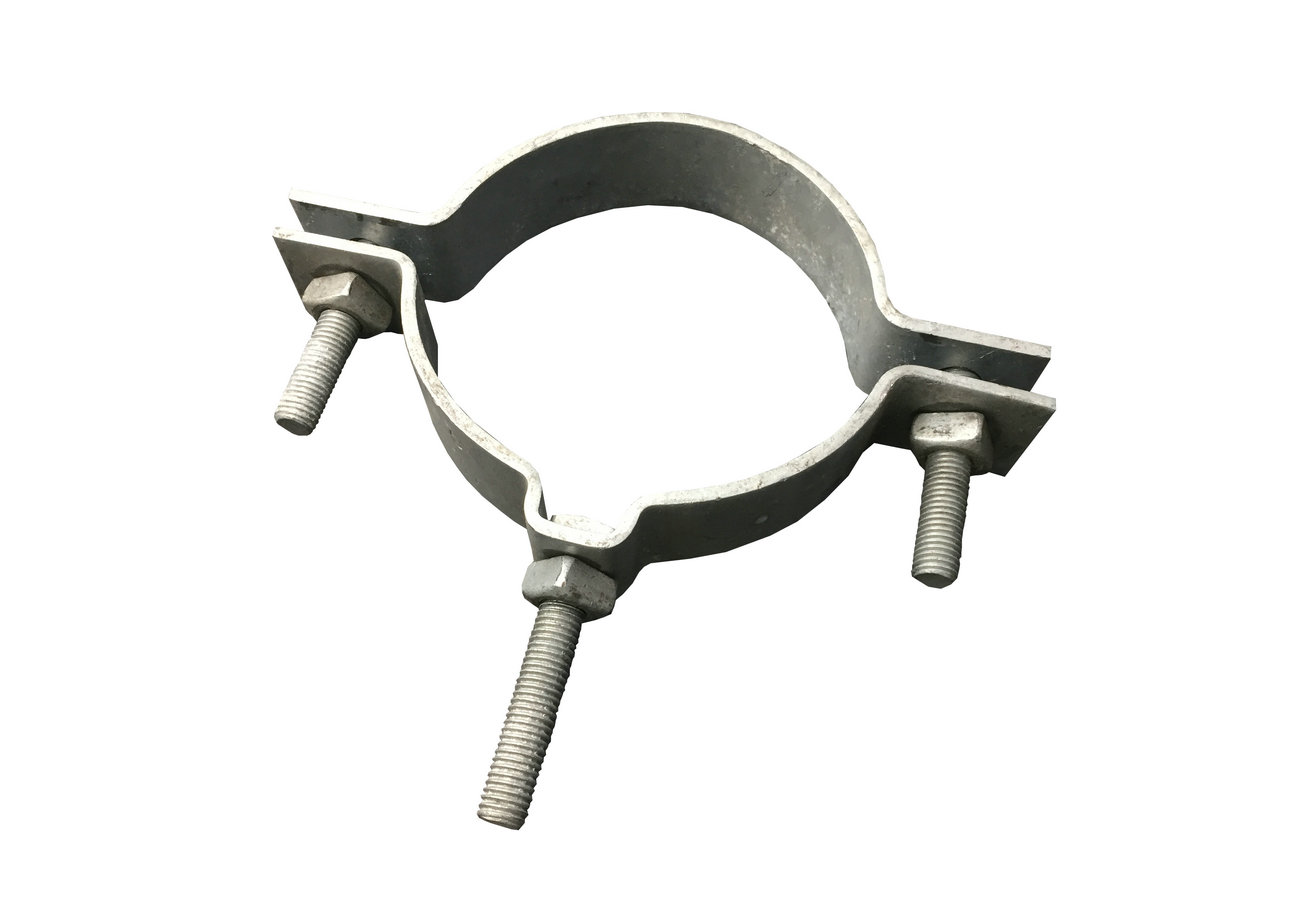
| RAX-PB-3B-220 | 3-Bolt Closed Circular | 7–9 in (178–229 mm) | 20,000 lb | 3 × M16 | Heavy distribution, deadend, transformer ground mount | 1.45 |
| RAX-PB-AD-240 | Adjustable Encircle | 8–10 in (203–254 mm) | 15,000 lb | 2 × M20 rod | Variable / tapered pole sections, field-adjustable | 1.80 |
| RAX-PB-LK-180 | Link Style (Half) | 7 in+ (178 mm+, expandable) | 30,000 lb | Modular bolt | Transmission, heavy guying (MacLean / Hubbell eq.) | 0.95 |
Application & Installation
Where it is used
- Crossarm and transformer mounting on distribution poles
- Insulator-pin bracket support for primary conductor terminations
- Deadend hardware attachment at line-angle and tap-off poles
- Guy-wire anchor mounting at the pole head (link-style for heavy guys)
- Service-drop bracket support on residential service poles
Installation sequence (single offset, open-style)
- Measure the pole diameter at the planned mount elevation; confirm it falls within the band’s range.
- Open the band’s hinge / split point and wrap around the pole.
- Align the two flanges and insert the M16 carriage bolts through the square slots.
- Hand-tighten the nuts on the far side of the pole.
- Torque each bolt evenly to 80–100 ft-lb in a cross pattern.
- Verify the band sits square to the pole axis; mis-set bands shift under load.
Buyer’s Guide: Pole Band
1. Five Pole Band Configurations Compared
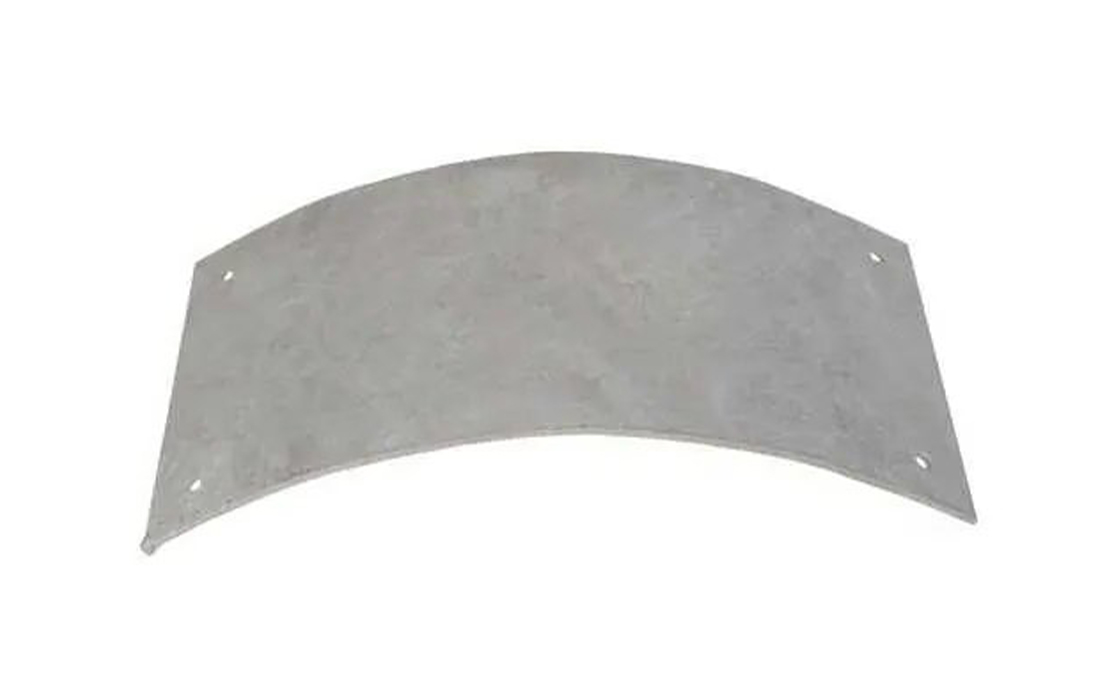
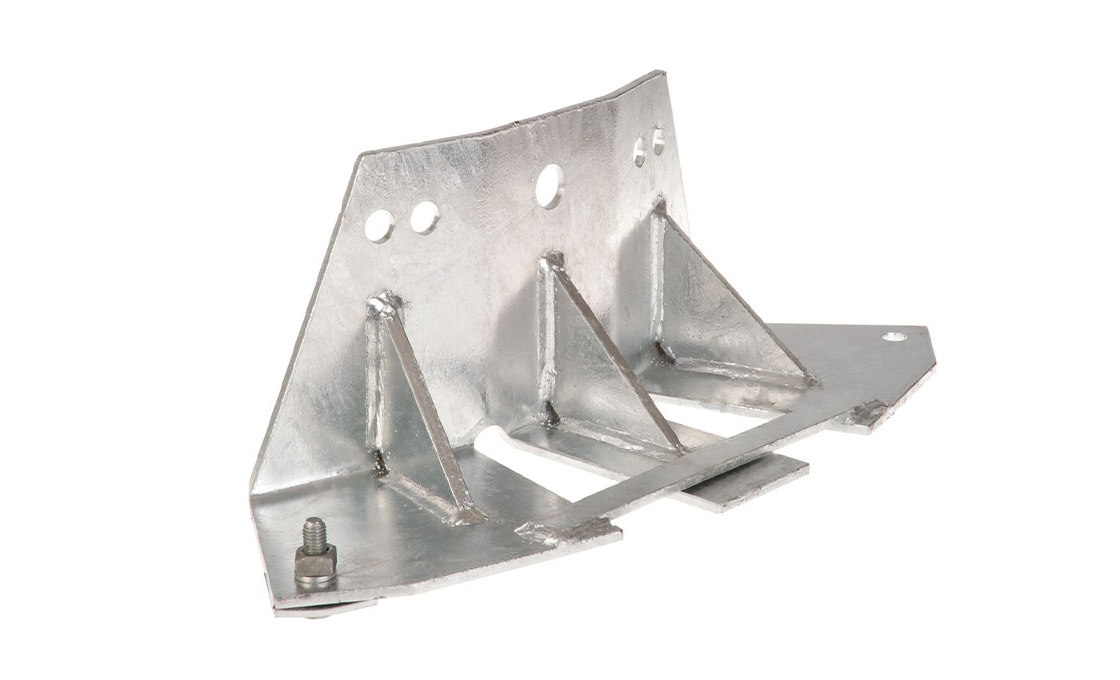
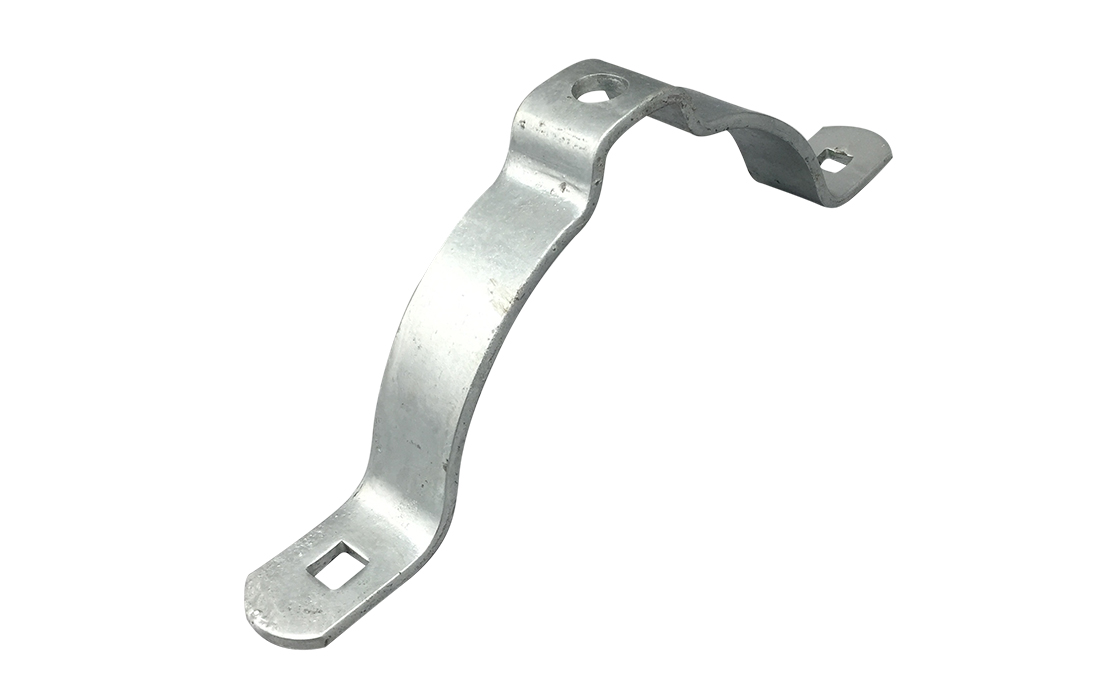
Industry uses five distinct pole-band structures, each suited to a different installation scenario. Single offset (RAX-PB-SO) is a two-piece flat strap that wraps around the pole and bolts on one side — the simplest, lightest band, used for light distribution hardware mounting. Double offset V-saddle (RAX-PB-DO) has flanges on both sides of the pole, providing dual hardware attachment points; ideal for crossarm or transformer mounts that require symmetrical loading. 3-bolt closed circular (RAX-PB-3B) is a one-piece ring that slips over the pole top during initial pole-setting — the strongest, most rigid mount, but cannot be retrofit once the pole is set. Adjustable encircle (RAX-PB-AD) uses two threaded rods at top and bottom to clamp around the pole within a ±20 mm range — handles tapered poles and absorbs surveying error. Link Style (RAX-PB-LK) is the MacLean / Hubbell-style modular band, built from individual links connected by eye-bolts; pole diameter range is theoretically unlimited and the band can be field-extended by adding links.
2. Sizing by Pole Diameter & ANSI Class
US utility poles are classified ANSI Class 1 through 10. Class 1 (heaviest distribution / transmission) has tip diameter ~9 in and butt diameter ~16–27 in depending on pole length. Class 5 (standard residential distribution) has tip ~6 in and butt ~11–14 in. Class 10 (light service / telecom only) tip ~5 in. Always measure the diameter at the planned mount elevation, NOT the butt or the tip — a 40 ft Class 4 pole has a tip of ~7 in and a butt of ~15 in, with a smooth taper of approximately 1/8 in per foot between. For a mount at 25 ft elevation: butt diameter (15 in) − (25 ft × 0.125 in/ft) = 11.9 in. Order the band whose range includes this exact measurement, not the nominal pole class.
3. Open Loop vs Closed Loop: When Each Is Required
Closed-loop bands (3-bolt circular, RAX-PB-3B) provide the strongest mount because the load is distributed evenly around the pole — no flange concentration. But they must be installed BEFORE the pole is set, because they slip over the pole top during pole-setting. Once a pole is in the ground, only open-loop bands (single / double offset, adjustable, link) can be installed; you cannot lift an energized pole to slip a closed band over its top. Specify band type at the project design stage, not at installation — retrofitting a closed band onto an existing pole is the most common procurement-to-installation mismatch we see, and the fix is a hot-line outage that no project schedule can absorb.
4. Single Offset vs Double Offset: Hardware Attachment Geometry
Single-offset bands (RAX-PB-SO) provide ONE hardware attachment point — typically a slot or square hole on one face for a single bolt. Use single offset for: service-drop brackets, telecom messenger mounts, single-arm crossarms, light insulator pins. Double-offset V-saddle bands (RAX-PB-DO) provide TWO attachment points 180° apart on opposite sides of the pole — balanced loading is the design intent. Use double offset for: full crossarm assemblies that mount through both sides, transformer mounts where the transformer hangs from a yoke spanning the pole, deadend hardware where two guy wires anchor at opposite angles. Mixing band types within a single hardware assembly leads to asymmetric loading and is a frequent inspection finding.
5. Link Style Bands for Variable / Tapered Pole Sections
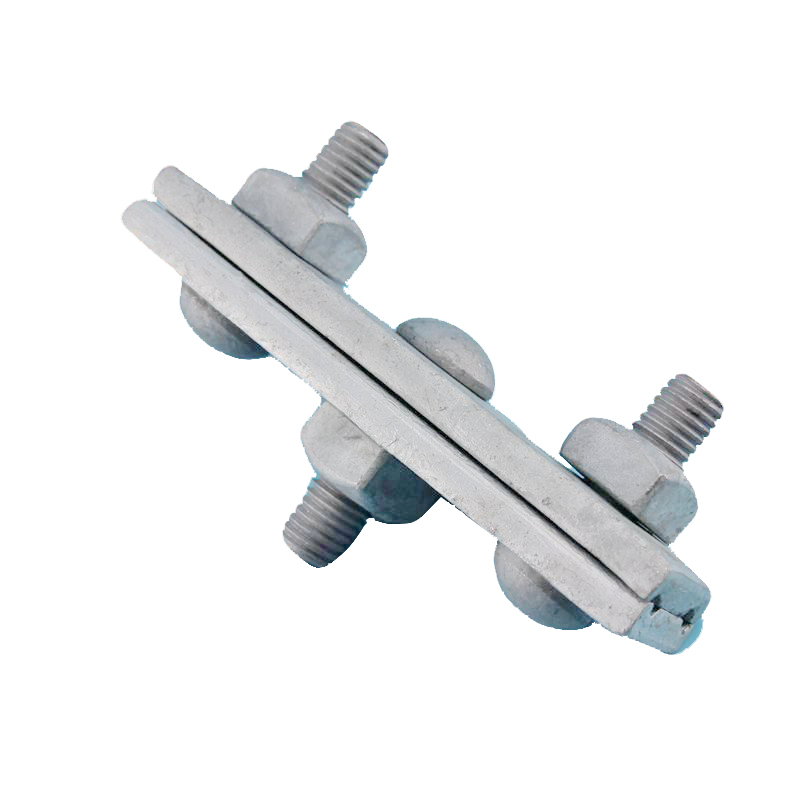
Link Style bands (RAX-PB-LK) are the modular alternative to fixed-size bands. Individual links connect via eye-bolts and the band can be configured for any pole diameter from 7 inches upward — you order the half-link starter unit plus the number of full-link extensions needed for your pole’s actual circumference. This is the standard for transmission lines where pole diameter varies along the run, and for projects where pre-installation measurement isn’t possible. MacLean Power Systems and Hubbell both manufacture the equivalent; RAX-PB-LK-180 matches MacLean’s link-style geometry and bolt pattern for direct catalog substitution. Tensile rating jumps to 30,000 lb in link configuration because the bolt-and-link joints are stronger than the flat-strap flange joints of single-offset bands.
6. Material & Galvanizing: Hot-Rolled Steel, Not Cut Sheet
The critical material spec for pole bands is hot-rolled carbon steel — NOT cold-rolled, NOT cut from sheet. Hot-rolled steel has the grain structure aligned along the rolling direction, which gives the band its high tensile rating and resistance to deformation under sustained load. Cut-sheet alternatives (which some Asian OEMs supply at lower price) fail in cyclic-load testing because the cold-formed grooves crack under repeated stress. All Raxsteel pole bands are hot-rolled carbon steel, galvanized to ASTM A153 Class B (minimum 86 μm zinc coating). For coastal C4 / industrial C5 environments specify duplex coating (HDG + polyester powder paint), which extends service life from 25 to 50+ years. Stainless 316L is available for the most aggressive environments — salt spray, geothermal, oilfield acid — with 10–14 day tooling and 100-piece minimum.