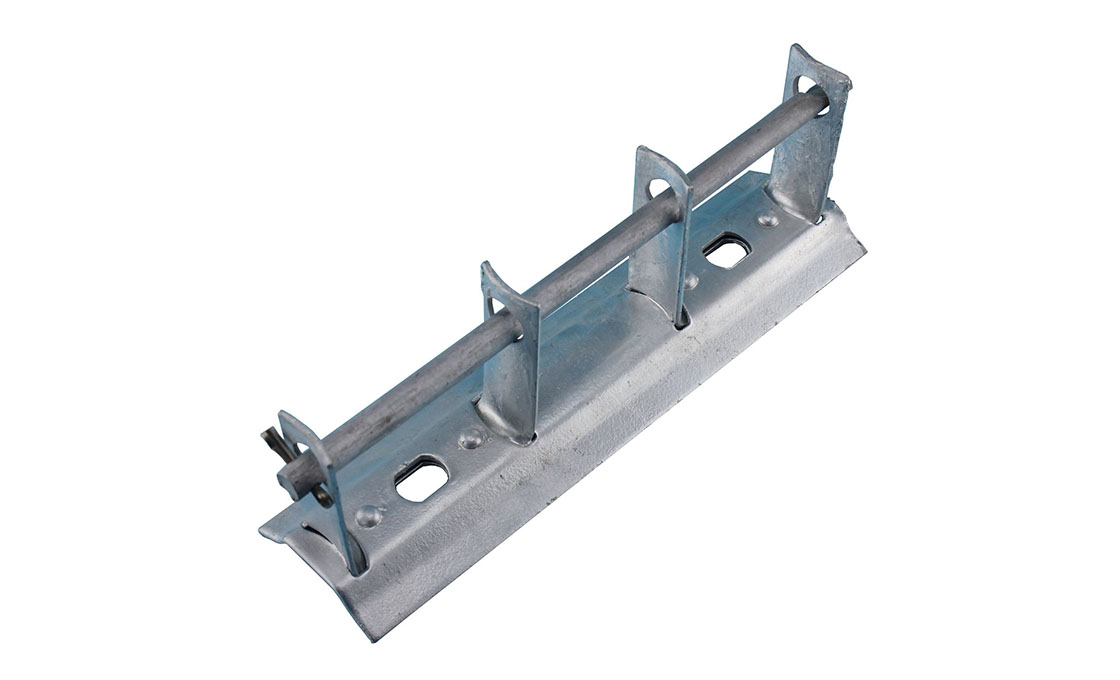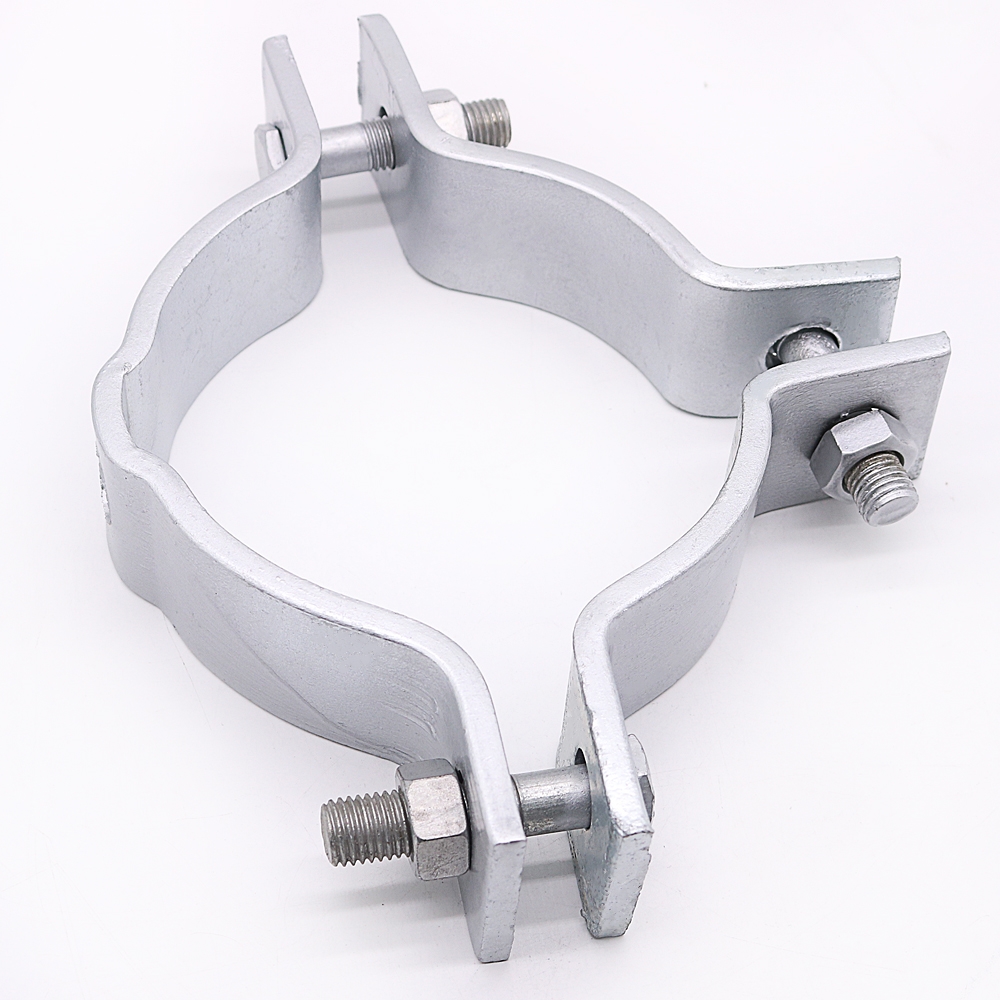
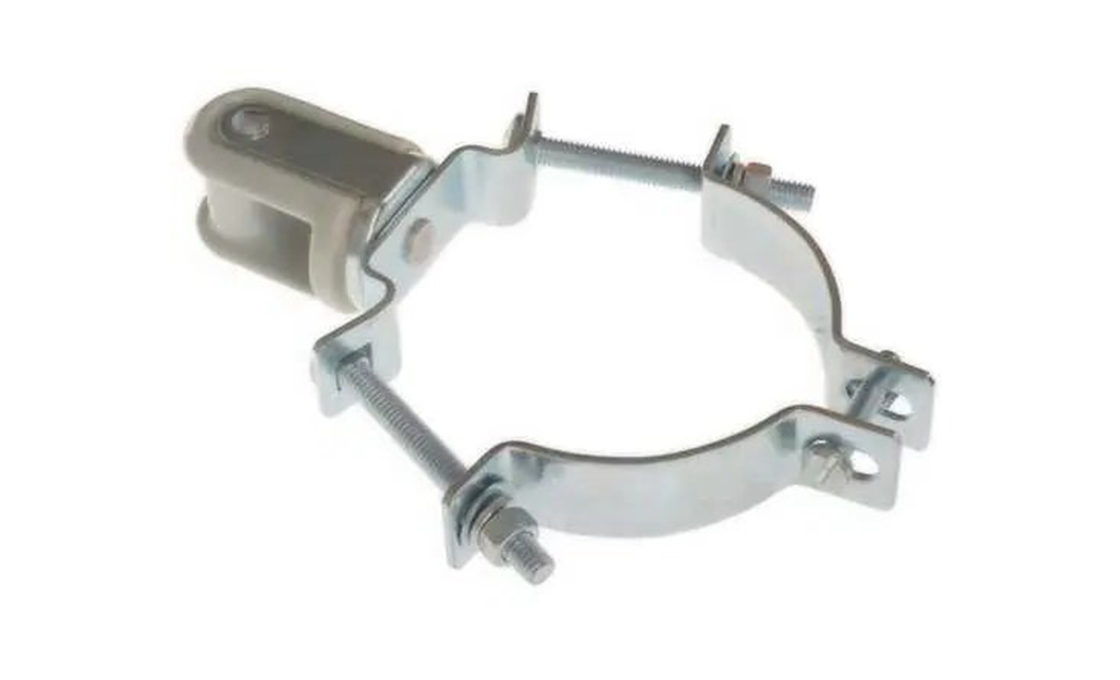
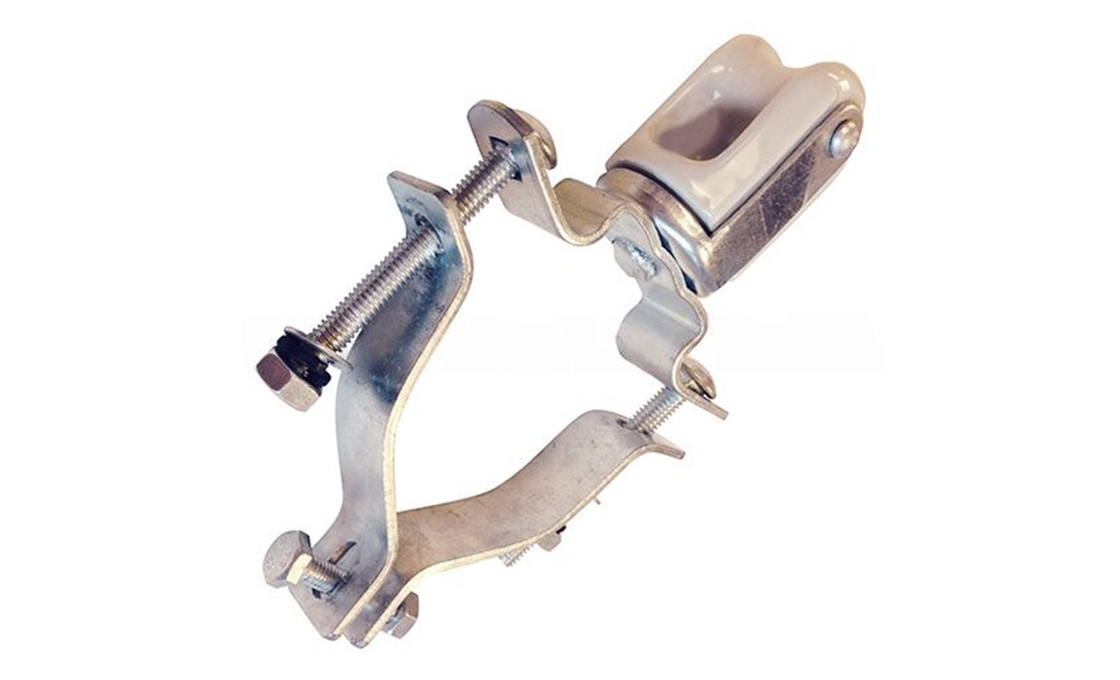
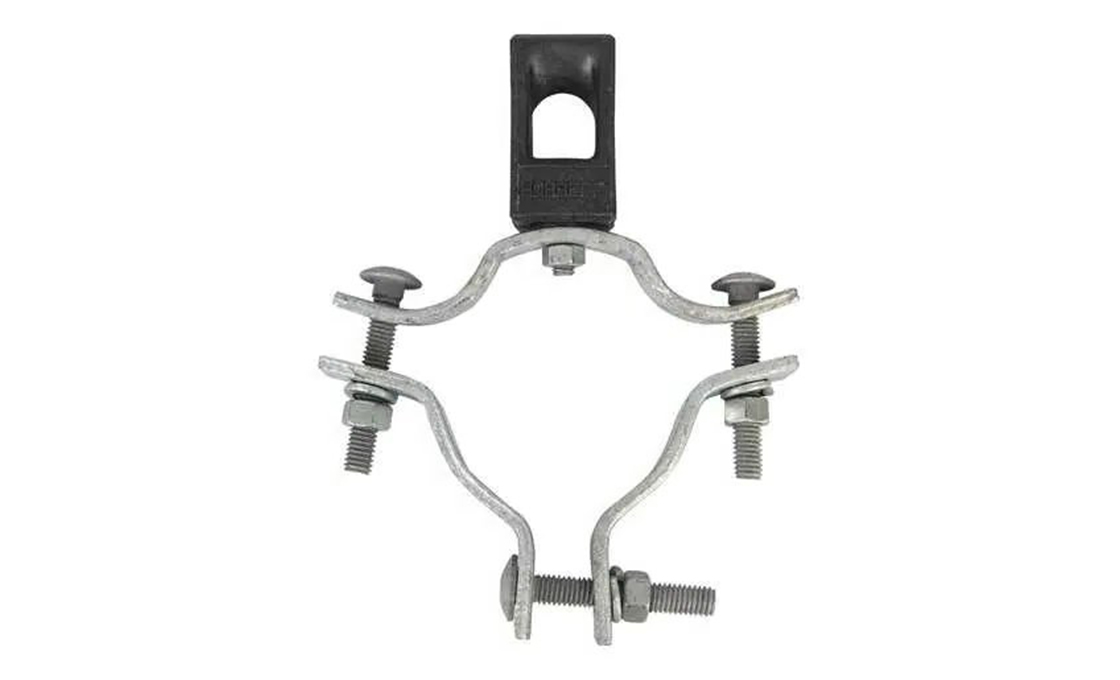
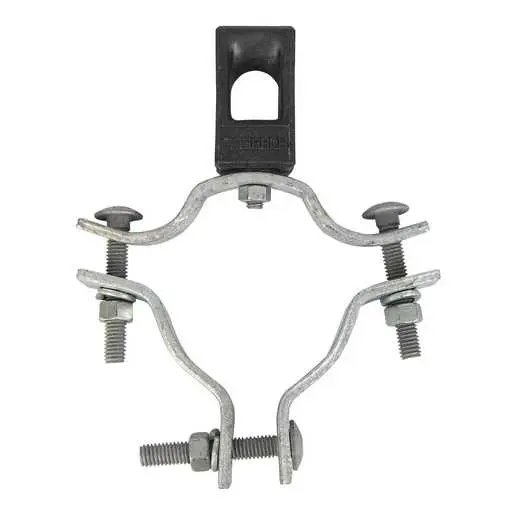
Porcelain Mast Mounted Wireholder
- Strap-on insulator clamp that wraps a rigid service mast (1-1/4″ to 4″ pipe) to hold the service-drop conductor at the masthead
- 6 types covering 1-1/4″ / 2″ / 2-1/2″ / 3″ / 4″ mast diameters + porcelain or HDPE insulator material
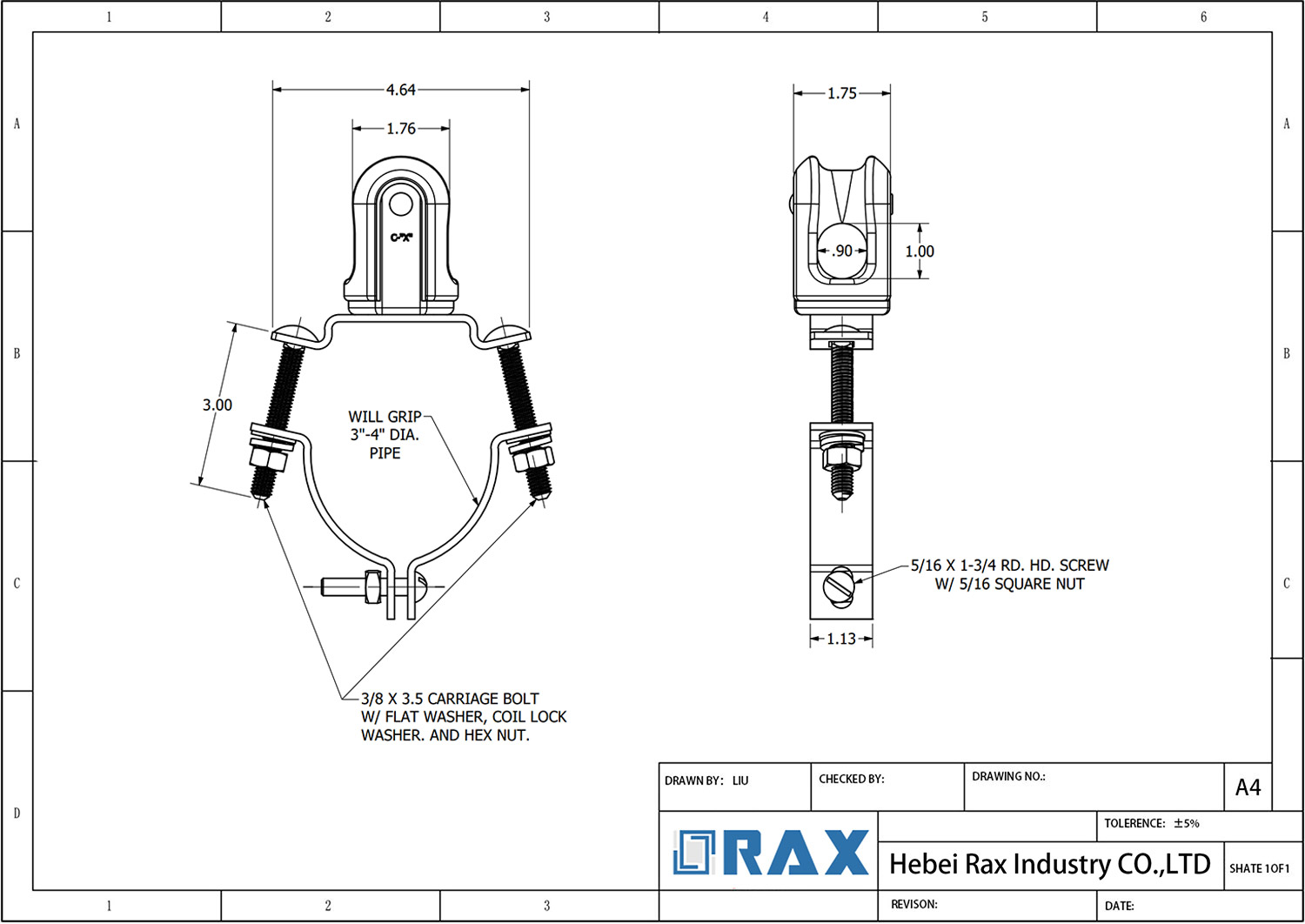
- Insulator slot fits service-drop conductor up to 0.9″ OD (typical AWG 6 triplex up to 4/0 quadruplex)
- Zinc-plated steel strap + ANSI gray porcelain insulator (Hubbell Chance series eq.)
Technical Specifications
| Catalog | Mast Pipe Size | Strap OD Fit | Insulator Material | Mounting Hardware | Hubbell Eq. | Wt (kg) |
|---|---|---|---|---|---|---|
| RAX-PMW-1-P | 1-1/4″ RMC | 1.66″ OD | ANSI 53-2 gray porcelain | 3/8″ carriage bolt + 5/16″ sq nut | Chance WS112 | 0.45 |
| RAX-PMW-2-P | 2″ RMC | 2.38″ OD | ANSI 53-2 gray porcelain | 3/8″ carriage bolt + 5/16″ sq nut | Chance WS200 | 0.55 |
| RAX-PMW-25-P | 2-1/2″ RMC | 2.88″ OD | ANSI 53-2 gray porcelain | 3/8″ carriage bolt + 5/16″ sq nut | Chance WS250 | 0.60 |
| RAX-PMW-3-P | 3″ RMC | 3.50″ OD | ANSI 53-2 gray porcelain | 3/8″×3.5″ carriage bolt + flat / coil lock washer + hex nut | Chance WS300 | 0.70 |
| RAX-PMW-4-P | 4″ RMC | 4.50″ OD | ANSI 53-2 gray porcelain | 3/8″×3.5″ carriage bolt + flat / coil lock washer + hex nut | Chance WS400 | 0.85 |
| RAX-PMW-3-H | 3″ RMC | 3.50″ OD | HDPE polymer (gray / black) | 3/8″×3.5″ carriage bolt + flat / coil lock washer + hex nut | Chance WS300-H | 0.65 |
Application & Installation

Where it is used
- Residential and small commercial service entrances where overhead service drop terminates at a customer-side rigid mast
- Apartment-style multi-meter service drops where each unit's mast carries a wireholder for the individual feeder
- Mobile home / RV park electrical pedestals using service mast configurations instead of pole-mounted drops
- Light commercial buildings (single-story retail, gas stations, small warehouses) with mast-style overhead service
- Retrofit on aged service masts where the original wireholder's strap has rusted through (the porcelain insulator typically survives if intact — re-use it on the new strap)
Installation sequence (3″ mast, residential 200 A service)
- Confirm the service mast is plumb and securely attached to the building per NEC 230 (typically through-the-roof with a weatherhead, anchored at 2 points: roof flashing + interior conduit support).
- Position the wireholder strap around the mast at the design height for the service drop attachment — minimum 10 ft above grade per NEC 230.24, typically 12–15 ft for clearance over driveways.
- Open the strap, wrap it around the mast, and engage the closure tab; finger-tighten the 3/8″ carriage bolt + nut.
- Orient the porcelain insulator so the wire slot faces toward the utility pole (the direction the service drop will run); the insulator slot should be horizontal.
- Final-torque the strap bolt to 15 ft·lb — the strap should not rotate around the mast under hand pressure but should NOT crush the conduit threads.
- Connect the service drop conductor: hook the conductor over the porcelain insulator's slot, then secure with a preformed dead-end grip or service wedge clamp (sold separately).
Buyer’s Guide: Porcelain Mast Mounted Wireholder
1. What the Mast-Mounted Wireholder Actually Does
A Porcelain Mast Mounted Wireholder is the insulated dead-end attachment at the masthead of a customer-side overhead service entrance. The service drop conductor running from the utility pole to the customer building cannot terminate directly on the bare service mast — the conductor is energized, the mast is bonded to ground via the service grounding electrode, and direct contact would create a phase-to-ground fault. The wireholder solves this by clamping a porcelain or HDPE insulator to the mast face; the conductor dead-ends on the insulator's wire slot, electrically isolated from the grounded mast. Required by NESC Rule 230 and NEC 230.51 on every overhead service entrance — not optional, regardless of voltage class.
2. Mast Diameter Selection — Match the Conduit Size
Service masts are made from Rigid Metal Conduit (RMC) in standard trade sizes: 1-1/4″ for 100 A residential, 2″ for 200 A residential, 2-1/2″ for 320 A residential / small commercial, 3″ for 400 A commercial, 4″ for 600 A heavy commercial. The wireholder's strap must match the actual outside diameter of the conduit, not the trade size: 1-1/4″ RMC = 1.66″ OD; 2″ RMC = 2.38″ OD; 3″ RMC = 3.50″ OD; 4″ RMC = 4.50″ OD. Pick the type column matching your conduit's actual OD (the spec table column is OD, not trade size). Wrong-sized straps either won't close (too small) or rotate around the mast under load (too large).
3. Porcelain vs HDPE Insulator — The Cold-Climate Question
ANSI 53-2 gray porcelain (the default) is the utility standard insulator material for service-voltage wireholders. Smooth glazed surface, 600 V rating, indestructible under normal service. The single weakness: porcelain micro-cracks at temperatures below -40°C through repeated freeze-thaw cycles, becoming a moisture entry path that eventually causes flashover. For utilities in zones with sustained extreme cold (Alaska, northern Canada, Scandinavia, northern Minnesota / Wisconsin), specify the HDPE polymer insulator variant (suffix -H) — high-density polyethylene with 2.5% carbon black UV stabilizer. Same 600 V rating, unbreakable, no freeze-thaw degradation. Cost premium ~$0.40 per holder.
4. Strap Material — Electrogalvanized vs HDG vs Stainless
The standard strap is electrogalvanized steel (zinc-plated by electrolysis to ~8 μm coating) — sufficient for most North American residential / commercial service environments where the strap is mounted near the building roofline and sees moderate weather. Hot-dip galvanized strap (+$0.40/holder) is the upgrade for coastal sites within 5 miles of saltwater, or for utilities in road salt zones — the 50+ μm HDG coating extends service life from ~15 years to 30+ years in those environments. Stainless 316L hardware (+$1.20/holder) is the ultimate upgrade for marina-served customers, oil refinery housing, or any inspection-critical site — 50+ year service with zero maintenance.
5. Service Drop Wire Compatibility — AWG 6 to 4/0 Triplex/Quadruplex
The insulator's wire slot is designed to cradle service-drop conductors with OD up to 0.9 inches. This covers the full range of typical residential and small commercial drops: AWG 6 triplex (residential 100 A, ~0.45″ OD), AWG 1/0 triplex (200 A, ~0.65″ OD), AWG 4/0 quadruplex (320 A 3-phase, ~0.85″ OD). Larger conductors (350 kcmil for 400 A+ services) won't seat in the slot — for those installs, specify the heavy-duty 1.2″-slot variant (suffix -HD at PO). The service-drop dead-end itself is NOT made at the insulator slot — a separate preformed dead-end grip or service wedge clamp takes the tension; the insulator provides only the electrical isolation.
6. Carriage Bolt Closure — Why Not a Hose Clamp
The wireholder closes with a 3/8″ carriage bolt (not a hose clamp or band tie) for three specific reasons. First, the bolt provides predictable, repeatable torque (15 ft·lb spec) that hose clamps can't achieve. Second, the bolt's square neck rotates into the strap's slot, providing positive anti-rotation — the conductor tension can't walk the holder around the mast. Third, the bolt + coil lock washer + hex nut combination is vibration-resistant — service drops swing in wind for decades; cheaper closures loosen over 5–10 years and cause holder drift. The cost difference between a carriage bolt and a hose clamp is ~$0.30, recovered within 2 years of avoided maintenance call-outs.